

I'll start by saying this:
The 60 Day Challenge is to set up some Facebook-like Ubisoft thing and keep it updated. It is also to play an hour inside the game. My Ubisoft page did not like to update, so it says I have a grand total of... 9 hours played, which is horse-shit. Next, I did not stick to playing the whole hour inside Rocksmith. I am going to practice wherever it inspires me to practice, and some days it was figuring out how far I can push my amp's tone shaping abilities; some days it was practicing unplugged on my porch while I watched it snow. Some days I spent 4 hours doing nothing but Session mode. Some days I did 45 minutes of Guitarcade and then switched to my amp. So technically I did not take the 60 day challenge "correctly" so take that how you will.
Day 60
Before...
It has been 60 days since I started using Rocksmith. When I began, I had some theoretical knowledge of what I was supposed to do with a guitar. I had some years of experience playing bass guitar. I could fake my way around to sounding like I could play something resembling blues. I have a sound file of me trying to make what I understood as "power chords" sound like a song. It is pretty terrible now that I listen to it. My fingers were awkward past the strings that my bass had. My picking was super sloppy, and so "wrong" that my finger nails were scrapping against the strings and hurting for days. Fretting on the thinnest strings hurt like hell, and felt like the strings were going to shred my finger tips. If someone showed me where to play, I could do some stuff... mostly sounding like a bassist trying to play guitar, but I could not come up with stuff on my own in a "correct" way.
After...
(next paragraph omits things I already learned by playing bass, the lists include only things I learn and attribute to Rocksmith)
After 60 days I have knowledge of the Pentatonic scales and how to use them in a band setting. This is directly attributed to Rocksmith because I practiced with the bands in the Session section of the game. I can improv play lead in whatever key a song calls for. My picking has come full circle, I now have a much better attack on the strings, especially strumming. My fingernails never touch the strings. My fret hand no longer hurts when I use them all around the neck. My fingers were numb for weeks while they got used to playing, but now have full feeling back in them, and retain their toughness with dealing with strings. I have a few pages of chords that I know from memory and can switch between many of them fast enough to play songs. I can sight recognize chords being played by people I watch. I can improv in blues, rock, heavy metal, and I can imitate 60's psychedelic rock, 70's hard rock, 90's indie alternative and punk, and several types of metal. I can do a little funk. I now can palm mute, use double stops effectively, play harmonics and somewhat tremolo pick.
What of Rocksmith?
I know I'm forgetting to list stuff. I think that's pretty good progress for 60 days with a "video game". I can fully recommend Rocksmith 2014. I also encourage people to not get the original 2013 edition, because all the things I highly love and have highly helped me are not features in 2013. Easily the most amazing thing about Rocksmith 2014 is the session mode, followed by Guitarcade and then the tone designer. I think that as time goes by I will find the Riff Repeater to be invaluable as well. Things in Rocksmith 2014 have pushed me further than I could have gone on my own by just practicing an hour a day by myself. I am much further than I thought I would get in the 60 days, not only in music theory and knowledge, but application as well.
Do I consider myself a guitarist?
That's a hard question. I do consider myself a bassist. So do I know as much on Guitar as I do on Bass? I think perhaps so. But then why will I not call myself a guitarist... it has got to be my hangup on chords. I just will not consider myself a guitarist till I can sit in with someone and have them say "its (insert chord progression) in the key of (insert key)" and be able to play that. In reality... if I have the balls to call myself a bassist, then I should be able to call myself a guitarist too. If I was asked, I would say "I could play a little guitar". So yea... I guess I'm a guitarist of the beginner variety. I do not know if I approached this as a beginner guitarist would though. I came at the game wanting to learn to be good at jamming and session stuff. I'm not here to learn some songs, I'm here to learn what to do during ALL songs. I'm not here to learn what someone came up, I'm here to learn how to come up with my own stuff. My musical goal is not to have a band, and play concerts. I want to get together with some friends, have some beers, and do some jam room rock. I'm well on my way to being able to do that.
Where do I go from here?
I hope you enjoyed reading my blog. I had fun doing the 60 day challenge, and I really hope to keep this pace in learning guitar. If this inspires you to get Rocksmith, let me know, it would make my day. Posts here will slow in pace. It will be added into rotation in my main blog that I link to my real life friends, and so perhaps one post a week.
What about your playing?
I am going to continue playing the Guitarcade, especially because it is fun. I am going to continue through the lessons as I come to things I need to know or practice. Songs I am going to do differently. I am going to come at the songs in game with a hybrid Rocksmith/Youtube approach. The session mode is still my #1 source of practice and would be worth buying the game for alone. 60 days are over, but I know I've only begun, as cheesey as that sounds today. The challenge never said that after 60 days you'd be a guitarist and know how to play a million different chords with only your pinky. It is a great start, however, and I certainly could recommend a beginner to do a 120 day challenge. Then a 180 day challenge, whatever keeps them practicing and playing.
Any final words?
Rocksmith is not a effortless method to learning guitar. Someone that is used to figuring out video games and working on accomplishing achievements and moving on is going to have problems. You can not approach it like a video game. You have to approach it like learning anything else. You have to redo lessons, you have to redo practice tracks, you have to repeat things over and over until it becomes muscle memory, and then do it again. Rocksmith is a lesson plan, it is a teaching tool, it is a learning device and a guitar technique encyclopedia. It is not a "get rich quick" scheme.
Do not under estimate the value of Ducks Redux.
Make something new.
Be creative.
If you're not creating,
you're consuming.
Be a creator, bring something new to this world.
Showing posts with label Playstation. Show all posts
Showing posts with label Playstation. Show all posts
Monday, February 24, 2014

Saturday, February 22, 2014
My bass and Day 58
My bass.

Where as my father was the one that helped me get my guitar equipment, it was my mother that helped me get my bass guitar.
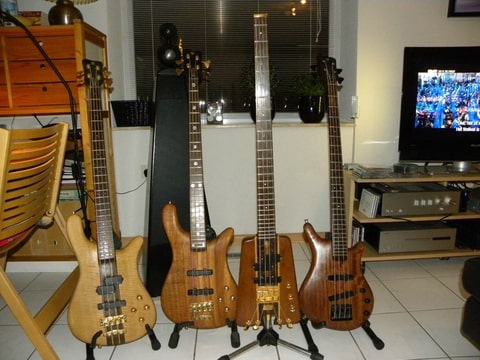 How far do I go back? Well. I never liked the look of Fender instruments. They looked too much like the era of cars I was never much into either. One day, while waiting for a friend to show up at a gaming shop, I went into the music shop next door. In there I saw, for the first time, a group of Warwick basses. These were unlike the stereotypical bass. They did not have an inch of thick paint and finish. They did not have these gigantic guitar inspired bodies. They looked like a piece of wood carved by hand into theses slick shapes that I had never seen before.
(pictured: someone luckier than I with a collection of Warwick basses)
It inspired me to pick up and play bass as my main instrument. I only casually looked at them, far too scared to touch instruments of this quality and cost. In fact, the cost of such instruments(a fraction of what they cost now actually) made my heart sink, but it was something to aspire for. There was one in particular though. This one was unlike the others as well. It was this creamy white... like the whole thing was made out of the same wood. When I moved around it, the woods shimmered as if it was a holograph... but it wasn't paint or holograph, it was a natural feature of the wood.
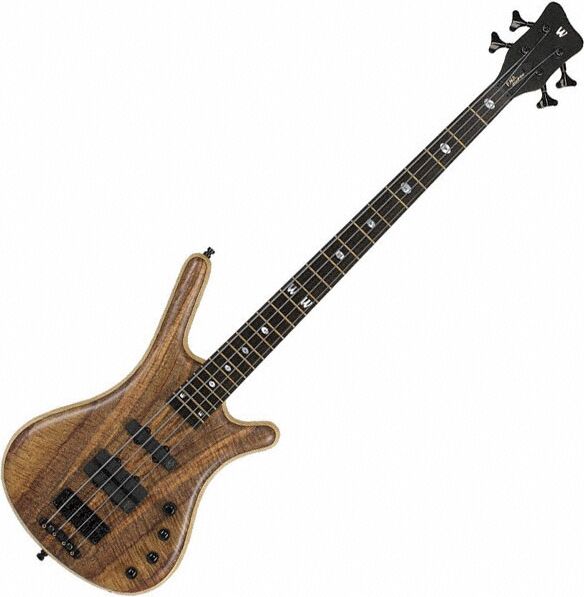 Years later I would be in a good job making enough money that I could possibly spend it on such a luxury. I know good gear doesn't make you a good player, but I wanted not excuses. If I sounded like shit with the best gear I could hope to have, then I had only myself to blame. Its motivation for me. I found out that, just my luck, this bass was a limited edition. Only made in the year 2003. The 2003 Bleach Blonde Thumb bass. I spent time looking for it, this was before it was so easy to find good stuff on the internet. I went to music shops all around for the next year and 1/2. I found a 2004 special edition, which was nothing like my white whale, in North Carolina. I was brave enough to play it, and it made me want my 2003 so much more.
(Pictured: 2004 ltd Corvette)
 I wanted this Bleach Blonde Thumb bass so badly that when I petitioned a friend to paint a piece of art for me, and I told them "whatever you want to do", they found the silhouette of a thumb bass and did that. By the time the painting was done though, it had happened. I found the bass online for sale at a major retailer. The problem was, my credit was not good enough to get an account to buy the bass. I just did not have the credit history. So my mother checked her rating and it was 1 dollar over what the bass cost. She let me order it using her credit, and soon I had my dream bass.
I've learned a lot with this bass. I've learned that I don't deserve it, and I'm not good enough to own it, but I work at getting that good. I learned I shouldn't own a bass I'm too afraid to hurt, ha. I've learned how to work on necks, adjust bridges, and fiddle with pre-amps. She has the sweetest, smoothest high registers I've yet to hear in a bass, and sometimes I get a fleeting amount of inspiration and make her sing like she really wants to. People warn about going out and getting an instrument that's too good for you, but sometimes it can teach you humility. Sometimes it works out.

Day 58
Better late than never. Still, I got the post in before the deadline ha.
I did play today, I just had things to do so I did not get the blog post done before I left the house. Rocksmith was a little rushed. I did 2 String Skip Saloons, 5 Scale Racers till I crashed, 2nd level of Castle Chordead till I died once, and a Gone Wailin' just because it had been a while. Then I went to practicing over on the amp.
I'm doing this thing where I'm remembering older 70's rock songs and just trying to play stuff that sounds similar to the main riffs. I'm moving around the neck and trying to pick out where it sounds most accurate. Maybe its helping train my ear? I have no idea, but I'll learn how close I was to a few of them later. With this exercise I'm coming up with some good sounding stuff myself. Stuff that sounds nothing like what I"m remembering in my head, but stuff that still sounds good. One of my favorite riffs is from me wanting to play something that sounds like "Magic Carpet Ride" on guitar. Its a song that I know the bass part of, one of the earliest I learned the bass part of, and so one day I'd like to be able to play it on guitar.
I need branch out a little bit. I know I feel an affinity to 70's rock, and blues based blues, but there's this whole section of light 'airy" rock riffs that I'd like to learn. I want to be able to copy John Fusciante's style in case I ever play with my one really good bass friend again. Higher registers just don't sit well with my ears, and I'm not really good at using them to produce music, so its something I really need to work on.
Friday, February 21, 2014
Gaining volume and day 57
Gain and Master Volume

To a bassist using solid state, the relationship between these two are very confusing. To a guitarist, it is a little more obvious. If you ask both what gain is, they'll usually give you a blank stair, and the guitarist will talk about getting a dirty signal.
If you look at a guitar as a signal transmitter, you can perhaps understand gain a bit more. The signal from your guitar is relatively low, that is why passive instruments with no batteries are still the most prevalent. The current created by the magnets and the strings is enough of a signal. When it gets to your amp, it will encounter 2 stages in most amp designs. The first stage is the "pre-amp". This is the stage where this tiny, small signal gets boosted. This is where your tone is "shaped", if you are to make changes to a signal, its much easier to fine tune the signal if it is larger. That is what the Gain does, its a knob that increases how big you transform your signal. If you make the signal very large, you get pre-amp distortion.
 (Pictured: to the left are the small pre-amp tubes, to the right are the large power amp tubes)
After the first Gain stage, the pre-amp, the signal goes to the power amp stage. Again, this stage takes whatever signal you give it and makes it much larger so that it can power the speakers enough to make a mechanical transition of the signal. If you have boosted the signal to great levels in the pre-amp using gain, then it will distort this power section as well. It also means you get a HUGE increase in volume. Power amp distortion causes the tubes to get very hot, and will wear out your amplifier components. Power amp tubes will glow with the fire of a thousand suns when overdriven hard.

That is why the Master Volume knob was invented. It sits between the Pre-amp and power amp stages(technically it is pre-amp). With it, you can bring down the signal strength before it gets to the power amp section, but it will let the pre-amp distortion through. Pre-amp distortion is popular because it is much lower heat and voltage, and is also cheaper to do all around. You can get that distorted sound while keeping the power tubes working at normal temperatures, and keep your ears from getting split from volume.
Solid state bassists, of which there are more than tube users these days, don't have this kind of distortion usually. So how do they know how much gain to use? Well... they get a helping hand.

Day 57
I have pretty much explored my guitar amp and can now manipulate it to do what I want fairly quickly. Not too bad for having it for a decade right? Yea lol. I made it a point to know how amp EQ works with bass. A lot of people I've known that played kind of have these super complex and powerful EQ's and have no idea what they're for. They max them or set it all at 12 o'clock and call it a day. Then they talk about needing this or that pedal for this sound. I wanted to get away from that. It is a habit of mine to see that kind of stuff and want to not be that way. When I got the Thunderfunk, I was like "I really REALLY need to educate myself if I'm going to have this kind of amp". I remember my bass bud coming over a good number of years back and him not being happy with not getting a Claypool sound.
"its gotta be his fingers or his carl thompson"
I informed him that Claypool likes to play full mids blasted. A "frowny" if you look at it on a graphic EQ. I EQ'd it in, and sure enough, there it was. He then played Tommy the Cat and made me realize how much I suck at bass. Anyway, recognizing EQ'ing and sounds has always been important to me.
So far I switch between as light a distortion as this amp can get(which is not very light lol) and a high gain metal sound, which it is surprisingly good at doing. Sometimes it gets pretty fuzzy too. I have some stuff to learn about the frequencies and how they interact with the band. Like, I don't know the mid frequencies in Guitar, so I don't know if boosting them will interfere with the bass player's sounds. The whole reason you do not want to scoop a bass live is that you kill "your" frequency. You boost where you overlap with the drums, and you muddy up the guitarist by interfering with his highs, while your relatively instrument free play area of the "mids" is cut all to hell. That's a "scoop", and its only great in your bedroom. I need to research the guitarist's play area. It sure seems a lot of people scoop a guitar and it seems more accepted.

To a bassist using solid state, the relationship between these two are very confusing. To a guitarist, it is a little more obvious. If you ask both what gain is, they'll usually give you a blank stair, and the guitarist will talk about getting a dirty signal.
If you look at a guitar as a signal transmitter, you can perhaps understand gain a bit more. The signal from your guitar is relatively low, that is why passive instruments with no batteries are still the most prevalent. The current created by the magnets and the strings is enough of a signal. When it gets to your amp, it will encounter 2 stages in most amp designs. The first stage is the "pre-amp". This is the stage where this tiny, small signal gets boosted. This is where your tone is "shaped", if you are to make changes to a signal, its much easier to fine tune the signal if it is larger. That is what the Gain does, its a knob that increases how big you transform your signal. If you make the signal very large, you get pre-amp distortion.

After the first Gain stage, the pre-amp, the signal goes to the power amp stage. Again, this stage takes whatever signal you give it and makes it much larger so that it can power the speakers enough to make a mechanical transition of the signal. If you have boosted the signal to great levels in the pre-amp using gain, then it will distort this power section as well. It also means you get a HUGE increase in volume. Power amp distortion causes the tubes to get very hot, and will wear out your amplifier components. Power amp tubes will glow with the fire of a thousand suns when overdriven hard.
(pictured: power tubes, some people aren't used to seeing things lit up like this in electronics unless its LED's)
That is why the Master Volume knob was invented. It sits between the Pre-amp and power amp stages(technically it is pre-amp). With it, you can bring down the signal strength before it gets to the power amp section, but it will let the pre-amp distortion through. Pre-amp distortion is popular because it is much lower heat and voltage, and is also cheaper to do all around. You can get that distorted sound while keeping the power tubes working at normal temperatures, and keep your ears from getting split from volume.
Solid state bassists, of which there are more than tube users these days, don't have this kind of distortion usually. So how do they know how much gain to use? Well... they get a helping hand.

Day 57
I have pretty much explored my guitar amp and can now manipulate it to do what I want fairly quickly. Not too bad for having it for a decade right? Yea lol. I made it a point to know how amp EQ works with bass. A lot of people I've known that played kind of have these super complex and powerful EQ's and have no idea what they're for. They max them or set it all at 12 o'clock and call it a day. Then they talk about needing this or that pedal for this sound. I wanted to get away from that. It is a habit of mine to see that kind of stuff and want to not be that way. When I got the Thunderfunk, I was like "I really REALLY need to educate myself if I'm going to have this kind of amp". I remember my bass bud coming over a good number of years back and him not being happy with not getting a Claypool sound.
"its gotta be his fingers or his carl thompson"
I informed him that Claypool likes to play full mids blasted. A "frowny" if you look at it on a graphic EQ. I EQ'd it in, and sure enough, there it was. He then played Tommy the Cat and made me realize how much I suck at bass. Anyway, recognizing EQ'ing and sounds has always been important to me.
So far I switch between as light a distortion as this amp can get(which is not very light lol) and a high gain metal sound, which it is surprisingly good at doing. Sometimes it gets pretty fuzzy too. I have some stuff to learn about the frequencies and how they interact with the band. Like, I don't know the mid frequencies in Guitar, so I don't know if boosting them will interfere with the bass player's sounds. The whole reason you do not want to scoop a bass live is that you kill "your" frequency. You boost where you overlap with the drums, and you muddy up the guitarist by interfering with his highs, while your relatively instrument free play area of the "mids" is cut all to hell. That's a "scoop", and its only great in your bedroom. I need to research the guitarist's play area. It sure seems a lot of people scoop a guitar and it seems more accepted.
Wednesday, February 19, 2014
Legendary: Hunterburst and day 55
The Mighty Hunter-burst Les Paul

Before playing his Appetite for Destruction Les Paul, Slash had a Les Paul that the whole band remembers as a turning moment in their careers. It was a sign that they were "making it" in the world of music. It inspired them to work harder, player better, and get stuff done. But this Les Paul did not make it with them to their debut album. What was with this Les Paul?
To start talking about the Hunterburst, we have to go back to the time. Today Les Pauls of all periods are coming out in droves, there are Les Pauls at every notch in a wallet. In the late 70's and early 80's, the only way to get a Gibson made "like they used to" was to find a Gibson made back then. I've said here before, for years Les Pauls were mistreated and thought of as lesser guitars. They went through periods where they were hated, periods where they cost dirt money, and periods where they sat on pawn shop walls for years.
Steve Hunter of Alice Cooper was tired of looking for "that perfect 50's Les Paul". He was not the only one. Los Angeles' music scene was a hub of custom guitars. Cheap customs were a way for a luthier to get skill for when that big dog comes knocking after hearing one of your guitars in a hip, new band. Steve was one of these big dogs. He got a Les Paul 50's copy made in the shop of Max Baranet. Max rented luthier space in his shop, and there were several working there at the time. Roman Rist, Max's apprentice, claims he spots several hallmarks that Max put into guitars, and that Max himself made it. Max did well over 150 instruments a year at the era, so its easy to see how he could not remember it. In pictures of the era, you can tell the Hunterburst from the AFD by the fact that the Hunterburst is a wider "quilt" maple top, while the AFD is more pinstripe flame.

Like many great Legendary instruments, the story of them starts with someone else not keeping it. Steve Hunter got into the Super Stratocaster scene that Eddie Van Halen fostered, and decided to be rid of his custom Les Paul copy. It went to the store of a guy named Howie Hubberman. Howie was notorious for giving struggling bands deals on credit and trade ins. Slash traded in a few of his guitars and was able to get The Hunterburst on credit. Howie says that Slash was always good for the money, but probably payed it off well after getting rid of the guitar.
Now why is this guitar legendary if Slash got rid of it? Well, Guns N Roses was not popular over night. The image that Slash created and still performs under today was not yet established. When he got the Hunterburst, that's when the band blew up. Everyone that was a part of the LA scene in the mid 80's saw Slash playing this guitar. Guns N Roses got their record deal on the back of the skill used with this guitar. The AFD guitar gets the glory, but when GNR was struggling, hungry and playing their hearts out as a means to make a living, it was the Hunterburst in Slash's hands.
The Hunterburst currently resides in a museum. Sadly it goes unplayed.
Day 55
If you are a musician well versed in theory, you're going to be bored by today's post. If you are not a musician, you'll probably be bored by today's post too.
I am redoing and fleshing out my rough pages before putting them in my notebook and today I did a diagram of all the parts of the Minor and Major Pentatonic scale. It hit me today that they overlap because they both use the same shapes. Maybe I'm under representing this somehow... I realized that a Major C Pentatonic in the first shape, is the same as a shifted Minor A. Now, the chord tones are different, but the shape and place, and notes are exact. This opens up my improving soooooooo much. Also, this means I can find any key in minor or major using the same shape.
Its kind of like finally seeing the forest for the trees.
I used the session mode to map this out. Again, it is so good for visualizing concepts that can be told to me, but sometimes I need a visual way of seeing it, which is why I have a habit of diagramming things on paper and in notebooks.
I am seeing the relationship not just the math of the theory. This is like the next step for me to be able to hear something, know what is being played, and being able to solo or rhythm over or under it and be "correct" and not just "noodling around till something sounds right". I could do it on paper, not just in practice, and other people will be able to look at it and say "yea I see what you're doing". It makes me feel like I'm becoming a musician, not just a guy that can "play some bass and guitar".
Tuesday, February 18, 2014
Actively Watching and Day 54
Actively watching.
I have noticed that in the interviews I watch with more recently famous guitarists, they talk about watching their heroes. They hardly ever talk about what they do themselves, and talk about who they were watching when they learned it. I saw an interview with Dan Auerbach of The Black Keys, and most of the interview was him talking about what he learned while talking to Billy Gibbons. The same interviewer talked to Billy Gibbons and guess what... all Billy talked about was the guitarists he got stuff from when he was 12 years old watching old blues players.
Back in the 90's, I had friends and relatives that had these massive stacks of VHS's and later DVD's of their favorite players. They had minutes and seconds memorized, they would go to remembered spots and say "look how he did this, I've been working on doing this for weeks" and "someone showed me this, but they were wrong, look how he does it live at this concert". Do not just watch people, ACTIVELY watch people. Watch their fingers, watch how they play, watch how they keep beat, don't just listen, WATCH. When you see them play, don't just think "that bend sounds cool" you should wonder "what note is he bending from and bending to?" or "was that a powerchord or am I missing what he's doing with his pinky?"
We now have Youtube and we don't have to chase down these stacks of videos. Youtube is going to be credited for the biggest inspiration to musicians since The Beatles. In twenty years all the players are going to be talking about who they watched or how much they watched Youtube. I do not quite seek out live performances yet, but I do watch a TON of gear reviews. Now, you might be saying, "you gearslut" but no, no wait, listen. The good reviewers have jam sessions and improv playing during their reviews. You can learn a lot while the camera is focused on the guitar being reviewed while they play. Find the people you like to watch playing doing their improv and you will learn MUCH more than when they play their own songs. You will get a peek inside their head, how they come up with phrases, sounds and songs.
I have also noticed in interviews that sometimes guitar players are doing things they don't realize are "mystical" or "difficult". Especially Billy Gibbons. It really sounds like he's surprised that people are marveled by some of the stuff he does. Instantly he can tell you what old blues player he learned that from, and he's always "oh its just a simple this right here". So it pays to watch. You might learn more watching actively than being taught passively. They do not keep their "secrets" on purpose, I'm finding that the players just do not know they are "secrets"
Day 54
Book learning day.
Well it started out as diagramming, and in the process of diagramming out the scales and keys I learned a lot. Things like lowest note on lowest string. I'm also seeing what patterns work with what chords. Well.. the chords I know. All this makes me sound like I know more than I do, please don't take that as me knowing my stuff haha. I am still in the dark about chord progressions and so I'm just beginning to learn basic ways of playing with that.
Rocksmith's Session mode taught me the single most transcendental thing I have ever learned when it comes to playing with people; find the key the chords are being played in and then you can play scale notes in that same key and sound like you belong there. It is probably "duh" to some people, but holy crap has it helped my confidence. I am diagramming the minor and major Pentatonic scales so I can learn my memory where each key is... and realizing that it is just the lowest note(most bass) on the lowest(thickest) string. It is something I should have already knew, but sometimes you can't see the forest for the trees.
I already knew the G minor pentatonic, E and D because I love playing in those keys. I "zoomed out" and learned the 2 frets to the left as well as the main shape. This is because I felt like the lowest notes on the B and high E were just not enough high notes to play in, so I extend it back. I did this mainly for when I was playing in G, but the beauty of the pent scale is that its the same wherever, so learning it for the G I automatically learn it for all other keys.
Rocksmith's session mode is SOOOO good for learning these lessons. It is so very good for taking notes with too. I get these questions in my head, and before I'd have to Google it and go through several pages of trying to translate someone talking about music to get my answer. With the session mode, I can change a few settings and... there I go. Its right there in front of me, visually in a way I can understand it, and it "clicks" in my head. Its like the best interactive theory book ever.
I have noticed that in the interviews I watch with more recently famous guitarists, they talk about watching their heroes. They hardly ever talk about what they do themselves, and talk about who they were watching when they learned it. I saw an interview with Dan Auerbach of The Black Keys, and most of the interview was him talking about what he learned while talking to Billy Gibbons. The same interviewer talked to Billy Gibbons and guess what... all Billy talked about was the guitarists he got stuff from when he was 12 years old watching old blues players.
Back in the 90's, I had friends and relatives that had these massive stacks of VHS's and later DVD's of their favorite players. They had minutes and seconds memorized, they would go to remembered spots and say "look how he did this, I've been working on doing this for weeks" and "someone showed me this, but they were wrong, look how he does it live at this concert". Do not just watch people, ACTIVELY watch people. Watch their fingers, watch how they play, watch how they keep beat, don't just listen, WATCH. When you see them play, don't just think "that bend sounds cool" you should wonder "what note is he bending from and bending to?" or "was that a powerchord or am I missing what he's doing with his pinky?"
We now have Youtube and we don't have to chase down these stacks of videos. Youtube is going to be credited for the biggest inspiration to musicians since The Beatles. In twenty years all the players are going to be talking about who they watched or how much they watched Youtube. I do not quite seek out live performances yet, but I do watch a TON of gear reviews. Now, you might be saying, "you gearslut" but no, no wait, listen. The good reviewers have jam sessions and improv playing during their reviews. You can learn a lot while the camera is focused on the guitar being reviewed while they play. Find the people you like to watch playing doing their improv and you will learn MUCH more than when they play their own songs. You will get a peek inside their head, how they come up with phrases, sounds and songs.
I have also noticed in interviews that sometimes guitar players are doing things they don't realize are "mystical" or "difficult". Especially Billy Gibbons. It really sounds like he's surprised that people are marveled by some of the stuff he does. Instantly he can tell you what old blues player he learned that from, and he's always "oh its just a simple this right here". So it pays to watch. You might learn more watching actively than being taught passively. They do not keep their "secrets" on purpose, I'm finding that the players just do not know they are "secrets"
Day 54
Book learning day.
Well it started out as diagramming, and in the process of diagramming out the scales and keys I learned a lot. Things like lowest note on lowest string. I'm also seeing what patterns work with what chords. Well.. the chords I know. All this makes me sound like I know more than I do, please don't take that as me knowing my stuff haha. I am still in the dark about chord progressions and so I'm just beginning to learn basic ways of playing with that.
Rocksmith's Session mode taught me the single most transcendental thing I have ever learned when it comes to playing with people; find the key the chords are being played in and then you can play scale notes in that same key and sound like you belong there. It is probably "duh" to some people, but holy crap has it helped my confidence. I am diagramming the minor and major Pentatonic scales so I can learn my memory where each key is... and realizing that it is just the lowest note(most bass) on the lowest(thickest) string. It is something I should have already knew, but sometimes you can't see the forest for the trees.
I already knew the G minor pentatonic, E and D because I love playing in those keys. I "zoomed out" and learned the 2 frets to the left as well as the main shape. This is because I felt like the lowest notes on the B and high E were just not enough high notes to play in, so I extend it back. I did this mainly for when I was playing in G, but the beauty of the pent scale is that its the same wherever, so learning it for the G I automatically learn it for all other keys.
Rocksmith's session mode is SOOOO good for learning these lessons. It is so very good for taking notes with too. I get these questions in my head, and before I'd have to Google it and go through several pages of trying to translate someone talking about music to get my answer. With the session mode, I can change a few settings and... there I go. Its right there in front of me, visually in a way I can understand it, and it "clicks" in my head. Its like the best interactive theory book ever.
Sunday, February 16, 2014
Spotlight Guitarcade: Temple of Bends and Day 52
Temple of Bends

The Temple of Bends is a game where a character walks along platforms. You use note bends to extend down vines that allow the character to traverse the platforms and progress through the level gathering treasure a long the way. While all of this is happening, the level is being flooded so that you are limited in time.

Temple of Bends reminds me of Pitfall at first, but also looks a bit like Donkey Kong Jr. Its style is certainly in the games of that era, with appropriate music. The problem I have with this game is that Bends are kind of wonky in Rocksmith. I hear that this game is doable and fun, but the fact that bends are not detected well in practice sessions have soured me on playing this game very much.
Maybe the bend detection is too touchy? Too precise? I know that "perfect" bending is touted as something Jimmy Hendrix did spot on, but maybe there should be a bit more forgiving detection in them at the start.
Day 52
I have had an epiphany... perhaps not a jump in playing skills, no, but I realized why learning songs in the Rocksmith way rubs me the wrong way.
First, I have to say, the fault is for sure mine. The solution is built right into the game's tools, I just got too frustrated to think of the solution while I'm learning a song. The way Rocksmith teaches you a song is that they give you the whole song, and you plink away at pieces throughout the whole song until you get the whole thing down.
Why does this sit wrong with me? At 75% of a song "mastered" you still can't play the song without Rocksmith and sound like you know what you're doing. At 65% of something as simple as Knocking on Heaven's Door, the song still sounds like plinks, plucks and bad guitar playing. You need that backing track to sound like you know what you're doing.
When I learn songs using Youtube, I learn the recognizable parts section by section. I'm probably at, ohh, maybe 10% of Black Betty being able to play, but you can tell the song I am playing in by the 2nd chord. So inside Rocksmith I can do the same. I just need to listen to the entire song, pick out the parts and Riff Repeat those parts over and over, and ignore trying to learn the whole song in one go like a Guitar Hero song.
I read a lot of people love the Rocksmith approach. They really see the "game" as a "game". They say it makes them feel accomplished rather early into learning the song and it works for them. The game offers a lot ways to learn if you dig and look. I'm going to keep learning Knockin' on Heaven's Door in the general way because I made a commitment, but it'll be the last song I learn in that way.
Saturday, February 15, 2014
TV Yellow and Day 51
TV Yellow

This finish, more than any, made me raise an eyebrow when I saw it. I would expect such a color from Fender, but not Gibson. Fender used surplus car paint supplies, and did the whole art deco clean look. Gibson, on the other hand, used stained and burst finishes that required much more time consuming, hand-crafted work. So what is up with this yellow finish?
 Well the hint is in the name. TV Yellow. The story goes that one of the Gibson people had visited the set of a medical drama during the 1950's. To their amazement, the entire staff of the hospital were clothed in yellow scrubs and yellow lab coats. It intrigued them, so they asked the people on the set. They told him that the glare of the lights in the studio would smear and reflect weird into the cameras, which were all black and white at the time. The Gibson guy knew instantly because they had the same problems with instruments used in live performances.
To a black and white TV, a yellow guitar appears as a very bright, white color. Gibson went further though, and they established a yellow color that looked yellow to the naked eye, but would show the wood grain when viewed through a television camera, making it seem like it was a very high quality, time consuming translucent white finish on the instrument.

The days of needing the TV Yellow color are over, but enough musicians used them in the past that they are now considered a staple finish, especially for the more streamlined models of the 60's that Gibson came out with, including the SG body styled Les Pauls, the Les Paul Jr's, and Les Paul double cut Specials.
Day 51
Knockin' on Heaven's door is still going. I'm doing what they recommend, and I've gone up about 10% mastery with it today. I guess that's working? I said I'd give the Rocksmith way of teaching songs a fair shake in these last 10 days of the challenge and so I'm sticking to it. It really does not seem that hard of a song.
I looked yesterday at my Ubisoft account, an account so old it had a password I know I had not used since my Everquest days. It says I have 3 games, but two of them are so old they aren't registering as games that the Ubisoft website can pull up lol. I'm thinking it was Shadowbane that tied me to the account. Anyway. It says 9 hours played! 9 hours??!? What the hell, I was past 9 hours in the first couple of days haha. I have no idea how its reading it, but its reading it very very wrongly. I know that I have not done all my 1 hour of playing inside Rocksmith, but I know from experience that I have waaaaaaay closer if not past 60 hours already. I've spent entire afternoons, 3+ hours in session mode, especially at the beginning.
I am so excited about the future. I do not see the 60 days being up as an "end" to the challenge, if anything I see it as a looming "its time to get down to business" thing. I plan on taking up through the bass route, and doing more in the rhythm section of the game. I'm going to put my nose to the grindstone learning 70's hard rock because it looks like I have a very good aptitude for it. Sadly the non-Zeppelin 70's rock, but the power chord and blues rock, yes. I'm already working Stranglehold, Black Betty, and Alright Now(by Free) into a combined melody. This blog should continue, maybe not daily, but in some compacity.

This finish, more than any, made me raise an eyebrow when I saw it. I would expect such a color from Fender, but not Gibson. Fender used surplus car paint supplies, and did the whole art deco clean look. Gibson, on the other hand, used stained and burst finishes that required much more time consuming, hand-crafted work. So what is up with this yellow finish?

To a black and white TV, a yellow guitar appears as a very bright, white color. Gibson went further though, and they established a yellow color that looked yellow to the naked eye, but would show the wood grain when viewed through a television camera, making it seem like it was a very high quality, time consuming translucent white finish on the instrument.
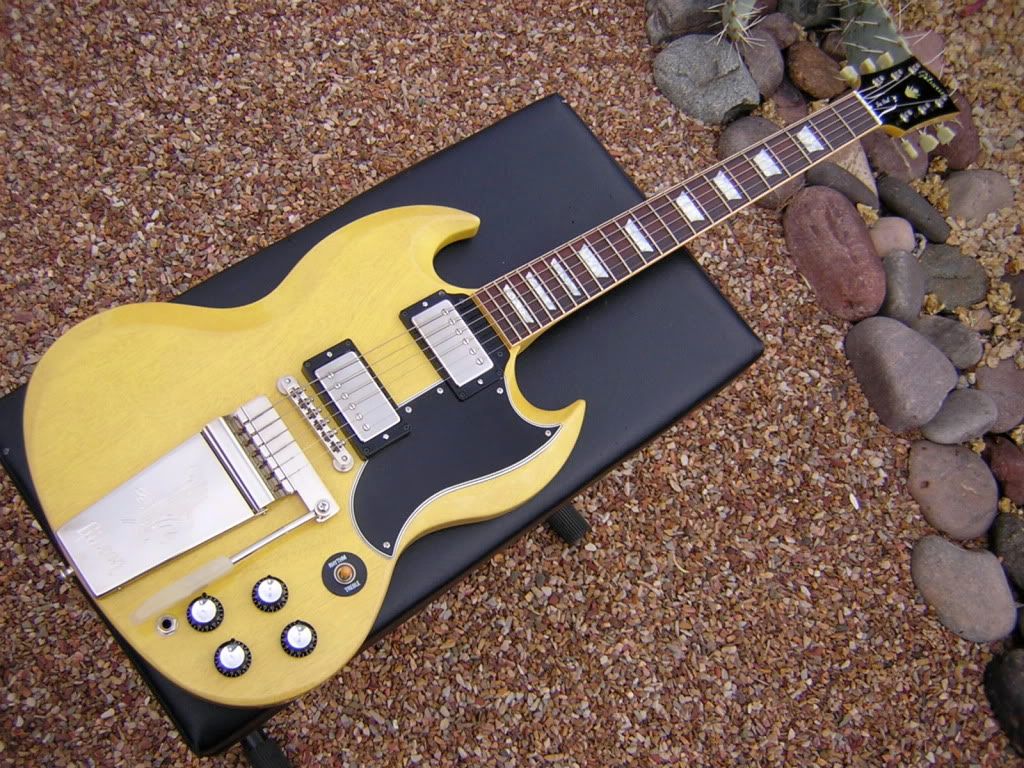
The days of needing the TV Yellow color are over, but enough musicians used them in the past that they are now considered a staple finish, especially for the more streamlined models of the 60's that Gibson came out with, including the SG body styled Les Pauls, the Les Paul Jr's, and Les Paul double cut Specials.
Day 51
Knockin' on Heaven's door is still going. I'm doing what they recommend, and I've gone up about 10% mastery with it today. I guess that's working? I said I'd give the Rocksmith way of teaching songs a fair shake in these last 10 days of the challenge and so I'm sticking to it. It really does not seem that hard of a song.
I looked yesterday at my Ubisoft account, an account so old it had a password I know I had not used since my Everquest days. It says I have 3 games, but two of them are so old they aren't registering as games that the Ubisoft website can pull up lol. I'm thinking it was Shadowbane that tied me to the account. Anyway. It says 9 hours played! 9 hours??!? What the hell, I was past 9 hours in the first couple of days haha. I have no idea how its reading it, but its reading it very very wrongly. I know that I have not done all my 1 hour of playing inside Rocksmith, but I know from experience that I have waaaaaaay closer if not past 60 hours already. I've spent entire afternoons, 3+ hours in session mode, especially at the beginning.
I am so excited about the future. I do not see the 60 days being up as an "end" to the challenge, if anything I see it as a looming "its time to get down to business" thing. I plan on taking up through the bass route, and doing more in the rhythm section of the game. I'm going to put my nose to the grindstone learning 70's hard rock because it looks like I have a very good aptitude for it. Sadly the non-Zeppelin 70's rock, but the power chord and blues rock, yes. I'm already working Stranglehold, Black Betty, and Alright Now(by Free) into a combined melody. This blog should continue, maybe not daily, but in some compacity.
Friday, February 14, 2014
Echoes and Day 50
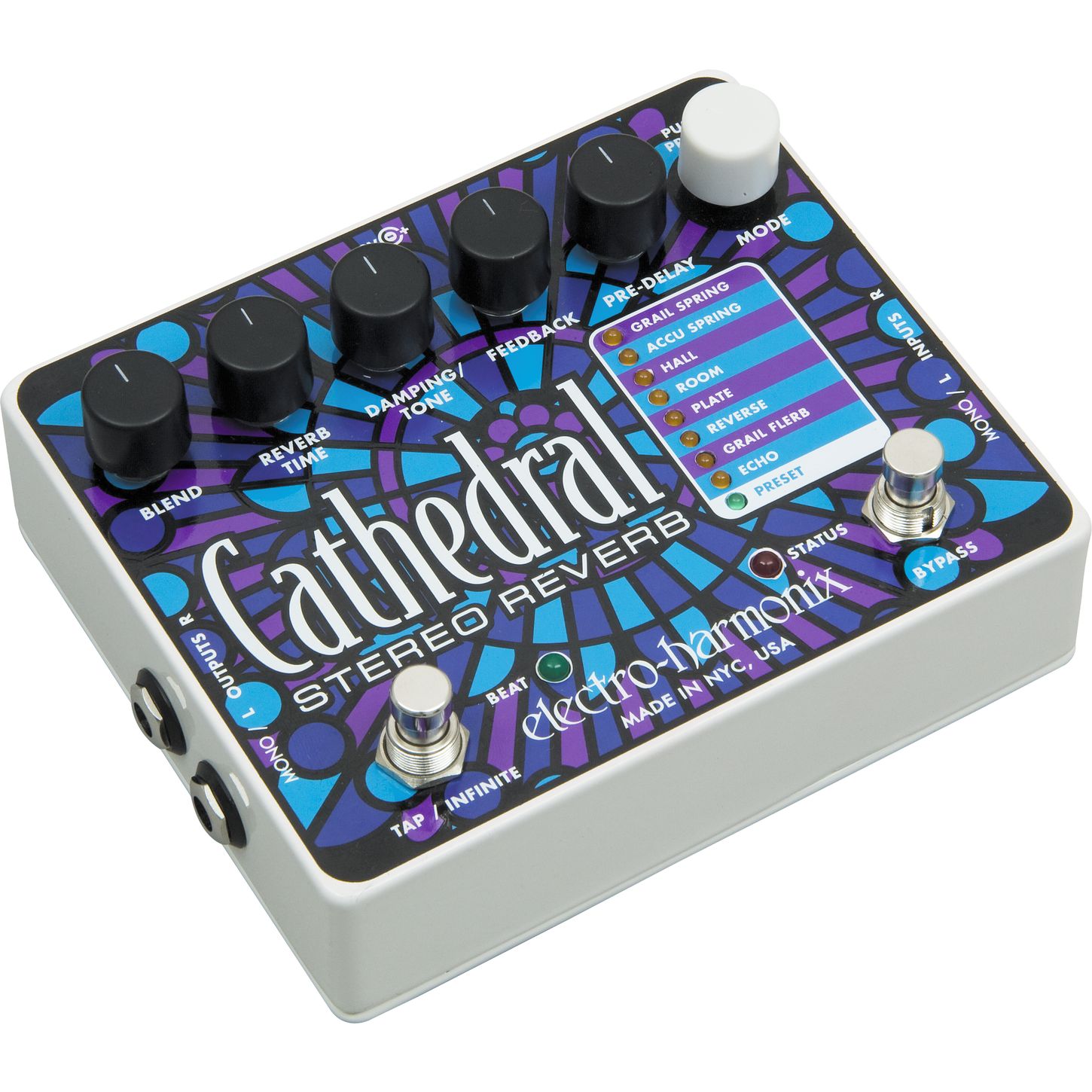
The sound of Reverb is the attempt to mimic the echo of the music reflecting back to the audience in certain acoustic spaces. Generally, like in real life, a reverb echo is many many copies of the original signal fed back into the signal chain at very quick intervals, but lowering in amplitude(volume) each time until it quickly is no longer audible. The real neat part of reverb is the ways it has been achieved.
 The first way that Reverb is made on purpose for recordings have been in "echo chambers". These are purpose built rooms with nothing more than a speaker and a microphone. The signal is played and real echos, real reverb, is recorded in the chamber. The only "fake" part about it is that the whole band is not playing inside. This technically means that the room can be arranged to produce "unnatural" echo effects that would not happen in a performance.
 Then came the plate and spring reverbs. They used a transducer to turn the signal into physical movement that would manipulate a piece of metal into creating reverb effects. At the other end of the metal would be a microphone to pick up the sounds. Plate reverbs can be huge, hundreds of pounds, but can be tweaked with many settings. Their size prohibits them from being portable, so are generally used as studio recording devices. Spring reverbs are not as precise, but can be made small enough to fit into amp models you can carry around. Fender are best known for including reverb in their amplifier combos in the 60's and 70's.

The plate and spring echo is the "classic" reverb sounds that are well accepted today. The flaw is that they create a false echo, not a real representation of the signal. Digital Reverb is the most common found now, as it is relatively easy to copy a signal and feed it back to create the echo. Unlike Plate or Spring which mimic a generic echo, digital can actually create the many signals found in real echo. Over time digital reverb now mimics the Plate and Spring reverb, and can even do their styles while actually using true copies of the signal, in many ways some find it superior. A good digital reverb can do all the types and blend them, and even do some strange ones.

Day 50
Ok, this is the home stretch. I'm going to think positive and work on learning a song from the game that I don't already know. Here we go: Aerosmith Walk this Way.
Ok. Screw that. If it was Ragdoll I could probably listen to it over and over while I learn... not so much with Walk This Way.
Knockin' on Heaven's Door. Ok, now this song I think I like enough to listen end on end while "learning" it in the game. I'm going to do it at least for 45 minutes every day till the end of the 60 day challenge. I'm not going to be pessimistic and I'm not going to say that how the game teaches songs is bad, I'm going to trust it and do its recommendations and I"m going to learn this song without going on Youtube. I want this game to teach me a song. A single song in the 60 day challenge.
Given, I did use Rocksmith to learn You Really Got Me, Everlong and Blitzkrieg Bop, I used a lot of youtube help with Everlong and I don't really play the version the game puts forth. The "lead" version, because again, it only sounds good if I'm playing it with a backup band. I opted to go for a more solo friendly version. You want me to sit there and plink out the lead verion, I can, but you'll soon go "oh I see what you mean".


The plate and spring echo is the "classic" reverb sounds that are well accepted today. The flaw is that they create a false echo, not a real representation of the signal. Digital Reverb is the most common found now, as it is relatively easy to copy a signal and feed it back to create the echo. Unlike Plate or Spring which mimic a generic echo, digital can actually create the many signals found in real echo. Over time digital reverb now mimics the Plate and Spring reverb, and can even do their styles while actually using true copies of the signal, in many ways some find it superior. A good digital reverb can do all the types and blend them, and even do some strange ones.
Day 50
Ok, this is the home stretch. I'm going to think positive and work on learning a song from the game that I don't already know. Here we go: Aerosmith Walk this Way.
Ok. Screw that. If it was Ragdoll I could probably listen to it over and over while I learn... not so much with Walk This Way.
Knockin' on Heaven's Door. Ok, now this song I think I like enough to listen end on end while "learning" it in the game. I'm going to do it at least for 45 minutes every day till the end of the 60 day challenge. I'm not going to be pessimistic and I'm not going to say that how the game teaches songs is bad, I'm going to trust it and do its recommendations and I"m going to learn this song without going on Youtube. I want this game to teach me a song. A single song in the 60 day challenge.
Given, I did use Rocksmith to learn You Really Got Me, Everlong and Blitzkrieg Bop, I used a lot of youtube help with Everlong and I don't really play the version the game puts forth. The "lead" version, because again, it only sounds good if I'm playing it with a backup band. I opted to go for a more solo friendly version. You want me to sit there and plink out the lead verion, I can, but you'll soon go "oh I see what you mean".
Thursday, February 13, 2014
Metal not lmletal and day 49
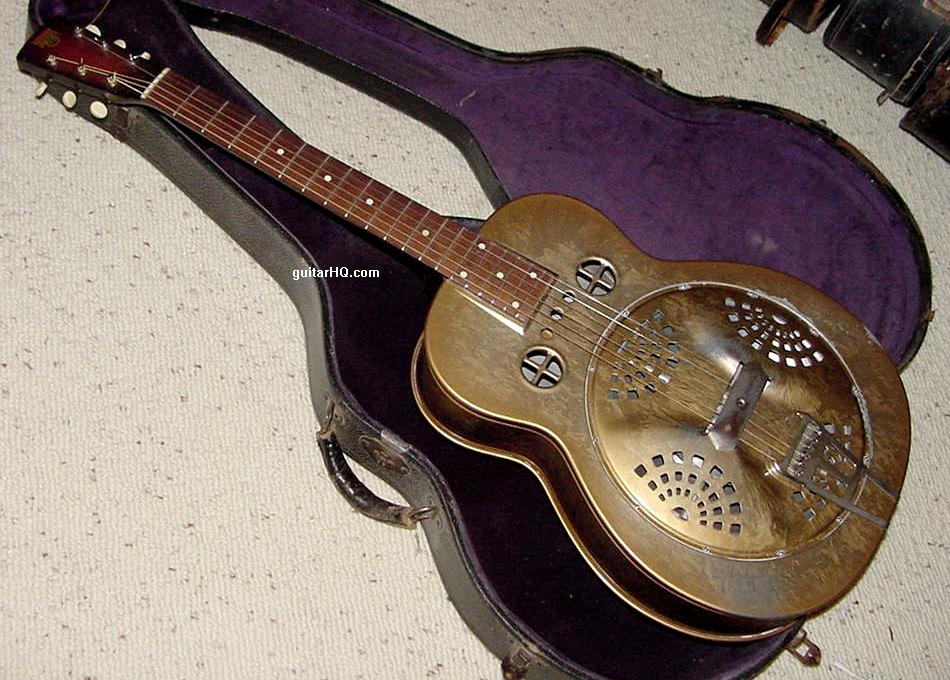
The problem of volume has always been with the guitar. Earlier strings instruments used bows and could have giant bodies to provide immense volumes. Eventually the body would get so large that you got out of the guitar's sound pocket and you'd be playing Bass. Any form of making a guitar larger ended up being more like larger string instruments like the Harp or the piano. This was all solved by electrical amplification in the 20th century, but right before that revolution an amazingly cool guitar style was invented.
 Resonators are guitars designed to work with metal parts to create a strong reflection of sound back to the audience. The sound was certainly louder than many acoustics of the time, but the metal really did give it a unique sound that did not work with most types of music at the time. Resonators became cheap, and easier to move around than having your own electrical PA system. The more "rural" types of music adopted these "outdated" instruments, and due to the sheer amount of usage they got in Bluegrass and blues, they are now accepted as mainstay sounds of those genre.
 Resonators have metal bowls and reflectors, known as "Cones" built under the strings to take the sound and reflect it back out into the audience. The originals used a 3 cone design, but a split in the company lead to a simpler and cheaper "dobro" design using a single cone. Further, you could get square necked resonators to play like a steel lap guitar, or the round neck variety to play more like a traditional guitar. Both are popular with slide guitar techniques.
Resonators, to me, rank as some of the most beautiful instruments ever created. There are entire guitars manufactured out of bell brass and engraved with patterns and designs that remind me of the dualing pistols of the 17th century. There are just as beautiful wood and metal combos that look like something out of a junk yard, but sound amazing.


Day 49
Still snowed in, but my hearth is still warmed by the awesomely burning light of ROCK.
or something Jack Black would say.... or maybe I'm watching too much Gearmanndude. Wait, same person aren't they? Has that myth been busted? I refuse to accept it.
Anyway. Somehow in between all the metal and rock, I came up with a very poppy guitar track. Sounds a bit like "Steady as She Goes" now that I sit here and think about it, but I think that I was channeling Nirvana's Nevermind when I was doing it. It is poppy, and its sorta happy sounding, but don't hold that against it, its fun to play! I swear. I'm really jonesing for a fuzz pedal these days. Its quickly looking like 70's rock may give way to some 90's alternative soon.
So I'm practicing Stranglehold and while looking at my "recommended" tab, there was Black Betty. Wow, it looks "doable" for me as well. Black Betty just has so much energy, I figured I wasn't ready for it, but I think with practice I can get it pretty quickly. It all goes back to my power chords having a lot more definition and sound to them. As I said before, they're becoming less punk and more 70's rock, and that's evident with the two new songs I'm practicing on. Black Betty has also been in my head because of Rayman Legends. There's a level on that where the bad guys play Black Betty while you bowl through them running from some monstrosity or another, and its highly entertaining.
Wednesday, February 12, 2014
Legendary: The Fool and Day 48
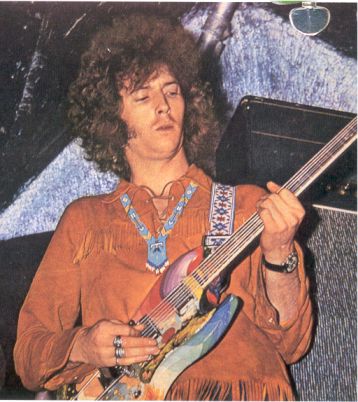
That's a Cream era Eric Clapton playing a Gibson SG known as "The Fool". You might not be able to figure out what is more shocking, the crazy paint job on that guitar, or Eric Clapton's 60's Fro. Either way, that picture does not really show off the guitar in an appreciable way.

The guitar itself is a 1964 standard. If you read my earlier history on the SG, then you know this makes it a "Les Paul Standard" of that era. Around this time there was a collective of Dutch artists known as "The Fool", and the psychedelic art movement had just come into full swing. Being a friend of George Harrison, Clapton thought Cream should get on the bandwagon and do a theme based on their artwork for the upcoming USA tour they were planning. "The Fool" did instruments for all band members, with Clapton getting this SG. In fact, it was the love of this SG that caused Clapton to gift "Lucy"(a previous Legendary instrument profiled on this blog) to Harrison.
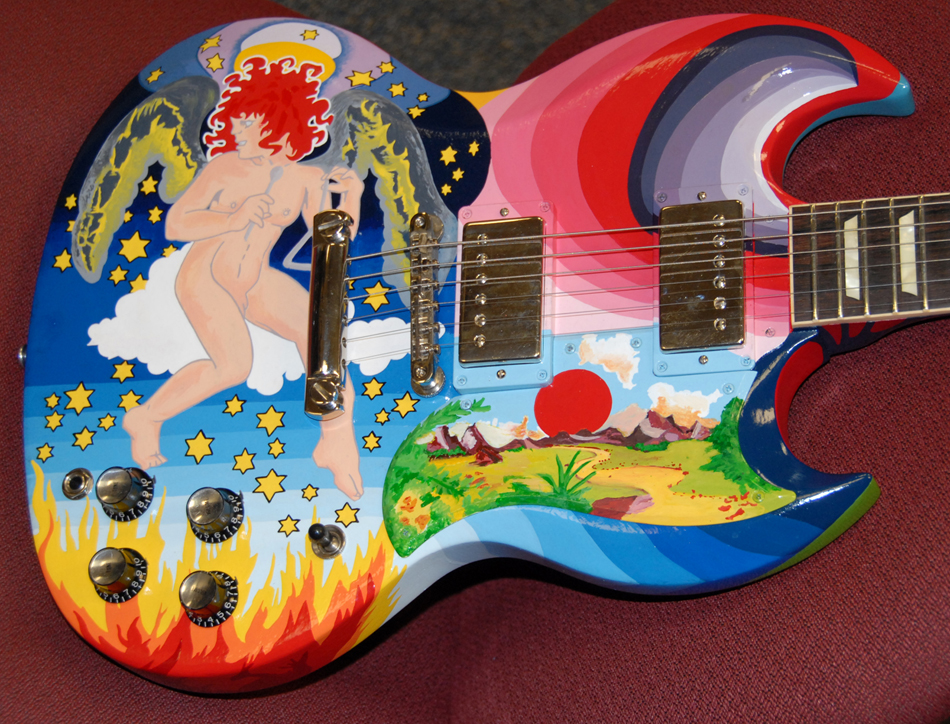 It was with The Fool that Clapton perfected his "Woman" sound that would dominate his music for decades. Unlike some artists, Clapton often records with the same instrument he plays live, so many of the later Cream albums were recorded with this exact guitar. After going through a few people's hands after Cream broke up in 1968, it landed in Todd Rundgren's hands for $500. Todd had seen Clapton play the guitar live, and it was this guitar that inspired Todd to go into the music industry. He kept the guitar for decades after, naming it Sunny because it was used to record Sunshine in Your Love. Todd is most known as a record producer, with credits like Bat Out of Hell by Meat Loaf. It later was sold for $150,000 but quickly sold a few years after that for $500,000. It now resides in a private collection, but by someone that at least loves to bring it out for magazines and interviews.
 Day 48
We come from the land of the ice and snow,
From the midnight sun where the hot springs flow.
The hammer of the gods will drive our ships to new lands,
To fight the horde, singing and crying: Valhalla, I am coming!
We're snowed in here, and so the vikings marched while the snow fell. Yep, more metal practice. I'm starting to work my new rock phrases into the palm mute stuff. I also plugged in the bass and tried my hands at making a matching track of that for what I'm playing.
Also I found out something: Ted Nugent is a dirty dirty old man. It turns out that his 70's stuff is very close to the way I play. I mean, almost exactly. He stays pentatonic, his hammer on flourish is EXACTLY like mine. Stranglehold is one of the most awesome riffs in rock history and it is almost exactly the kind of playing I do when I'm practicing. So if Ted Nugent promises to do certain sexual favors for you if you can play Stranglehold, he's not saying that its hard, he's daring you to take him up on the offer.
Dirty dirty Mot&(*Fu^k#@r
Tuesday, February 11, 2014
A Funky Family Tree and day 47

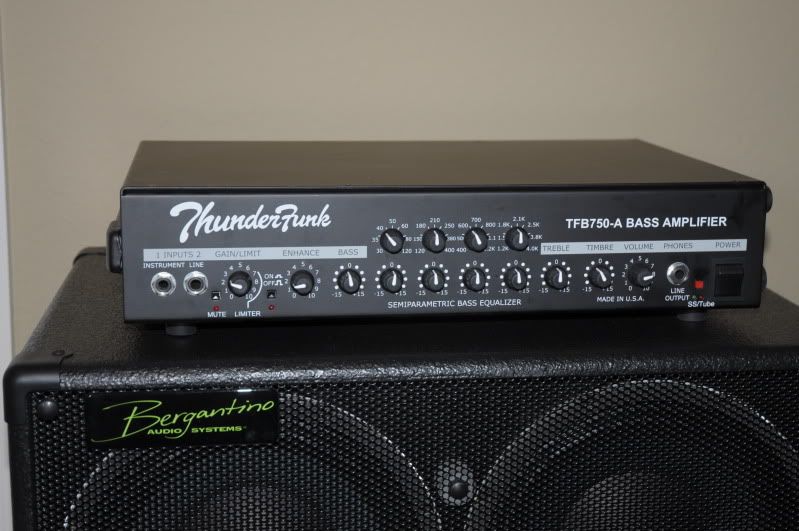
Oh neat. That looks kinda similar.


Hey! That one looks differen.... oh wait. No it doesn't, they just use sliders on the top.
So what is going on here? Well, what we have here is the legacy of a man named Russ Allee. Mr. Allee helped create one of the first "serious" solid state amps that were meant to replace tube amps with bass. You see, a very long time ago an obscure bass player by the name of Paul McCartney plugged directly into a recording console and made this beautifully clear bass tone. His band, called The Beatles, became huge and people loved this tone, and so extremely tight and clean tone became acceptable for bass.
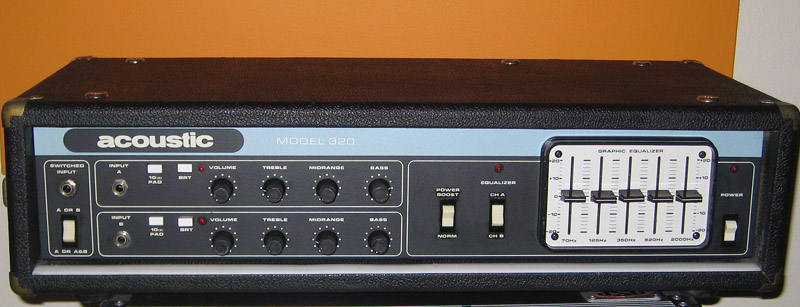 The Acoustic series of amps came along and were adopted by a couple of famous bassists, namely Jaco Pastorious, that wanted that clean "direct into the console" sound in a live setting. Russ Allee designed the pre-amp section that you see comes down to us through time in other amp designs. They are all connected to him. Russ worked with Steve Rabe to create the AMP420. Steve Rabe later started the company SWR and designed the SWR SM-400. He added to and changed the design by incorporating tubes. Steve wanted to do some new cabinets, ones that would take advantage of the new super precise solid state amps, so he hired David Nordschow to help him design them. Nordschow later went on to create Eden amps(the first amp listed up there). The Eden World Tour camps were their second set of designs, which he had consultation with... Mr. Russ Allee. Eden took the original designs of Allee, but added the newer parts that SWR had, namely tubes in the pre-amp.
Well what about the Gibson and the Thunderfunk? Well AMP was bought by Gibson, and with its design Gibson made the GB440 that is pictured up there. This, however, was not a long lived line, they boxed up all the old backstock and parts and put them in a ware house where a man named David Funk bought the building and the rights to everything in the building. He would be surprised to find all these parts to amps, and being an amp expert himself, decided to put them together and sell them. He changed and improved the components and created the Thunderfunk.
Thanks to Ivan Mike and various other Talkbass alumni for schooling me in the pedigree of my favorite amp.
Day 47
It is a funny thing. Somehow if I'm playing metal, I can be responsible with the volume. I know I miss the "feel" of the deep bass during a palm mute, but I know I'm still doing them. Blues, well that's pretty simple to do quietly, lowering the volume on my amp actually helps me get a less driven sound. Crunch tones are no so dependent on volume, the whole point of the solid state pre-amp section of my Marshall was to make sure you can get lots of crunch at bedroom levels. I should not have to care about volume for Crunch. I tune in the ACDC crunch though, and I can't help but crank the volume up. I guess its the 10 year old that always wanted to play Highway to Hell in me or something.
We're getting to the home stretch now aren't we? That day 60 is creeping up. I can also see reader fatigue, I can tell how many views and all that. It has lasted longer than I thought. I am lucky in that I knew from the start that this blog was done for me. So even if my views go to zero, I still will continue this because it keeps me responsible, it keeps me playing, and it keeps me writing. Still, I hope someone out there reads my little history of the tech blogs and my guitar profiles and maybe finds something interesting in all of this for themselves.
I have so many plans for after Day 60 that I feel like I am losing out on the "now". I do have a sort of creeping thought that maybe I'm not utilizing Rocksmith as much as should, but I have to remind myself that it is a tool, and it is not like I'm stagnant. I'm still using Rocksmith every day. Jam sessions are a must for me to keep interest. I play around with the tone designer, trying to match tones to songs that aren't in the game. Guitarcade, come on, that stuff is fun even if you're not learning guitar. I guess I'm just hoping for that next "breakthrough" to happen. I understand that those "breakthroughs" come slower and farther in between as time goes by, but I guess I'm just an optimist... which isn't really a descriptor of me usually, but yea.
Monday, February 10, 2014
Spotlight Guitarcade: Gone Wailin' and day 46
Gone Wailin'

The first and most simple game in the Guitarcade is Gone Wailin'. The game's premise is simple: the background is going to scroll, a wail is going to shoot you into the air as you make noise on the guitar. Use this to collect bananas, avoid birds and islands. The level is randomized and gets faster as you go.
 Let it be known that I tried for all of 5 minutes(almost no time when it comes to me) to find what this game is based on. I figured it was based on an old game like all the other games, but now I am convinced that this is just a take on the tablet/phone game Jetpack Joyride. In Jetpack Joyride you touch the screen to fly up, and let go of it to fly down(the satanic Flappy Bird was not in existence when this game was made).
When I first played Gone Wailin' I thought it was fun but I also thought that there was no way this game would help me. I thought to myself "I know how to make noise on my damn guitar". I was stubborn in the early days and determined to take everything serious about Rocksmith 2014, and I am glad I did. Eventually I realized that I had stopped banging on the strings trying to make as much noise as I could in a punk style, and ralized that its much easier to slowly strum and just maximize the amount of string vibrations. That helped me when it came to chord work. For beginners, this game is essential and I would not advise them to stop using it even past the 60 days. Why? Its a muscle builder. My hands do not fatigue easily because of my prior bass playing experiences, but I remember when they did. This game will help build stamina.
Also it really is fun.
Day 46
I've got a huge, nerdy post about bass amps coming up, but I feel like I've had too much bass coverage recently, and seeing as this blog is based on me learning guitar it feels a little out of place. Bass has been a big part of my life, so its only natural some of that bleeds in.
Sore throat still going on.
I am now officially recognizing that I am getting better at guitar. It is 46 days in, and I know I am much much better than I was when I first began. Rocksmith has definitely helped me, not only with learning the basics, but also with keeping my interest in playing every day. Too many times I used to think "well I have a lot to do, I can put that off till tomorrow" and just like the Credence Clearwater song says, someday never comes. The chords I know are making their way into practice. My power chords are sounding much less punk and much more 70's rock these days. My busy blues style is learning to fill space with more than just notes. I am not a guitarist yet, and I would not say I'm good at guitar, but I have improved from Day 1, you would not even recognize what I was doing on Day 1 as anything but "screwing around with a guitar".
I need to update my technique book. I'm not doing a lot of song learning, just as I planned, so I only have one notebook to update. I still have not committed as scholarly as I should, but I know myself and I know I can not resist making an "essay" out of learning guitar lol. One of the first things I am going to do after Day 60 is get a "song writing" book. Some of you may laugh at learning song structure and maybe even think "isn't that something you should just... you know... do?" and to that I laugh. If you spit in the face of people that learned song structure through reading, then you should probably never listen to Led Zeppelin again. I do not have a support network of musicians to just "tell" me how to do all things. What's with this attitude of glorifying ignorance and putting down learning these days?
Sunday, February 9, 2014
Fuzzy Memories and Day 45

In the fuzz world there's a big debate between fuzzes. Originally the most popular was the Fuzz Face, a huge, weird, round pedal with one thing going for it; Jimi Hendrix used them. Thing is, by the time they became a "known" and that there was a large enough market for them, the Fuzz Face "formula" was changed to using a different chip.
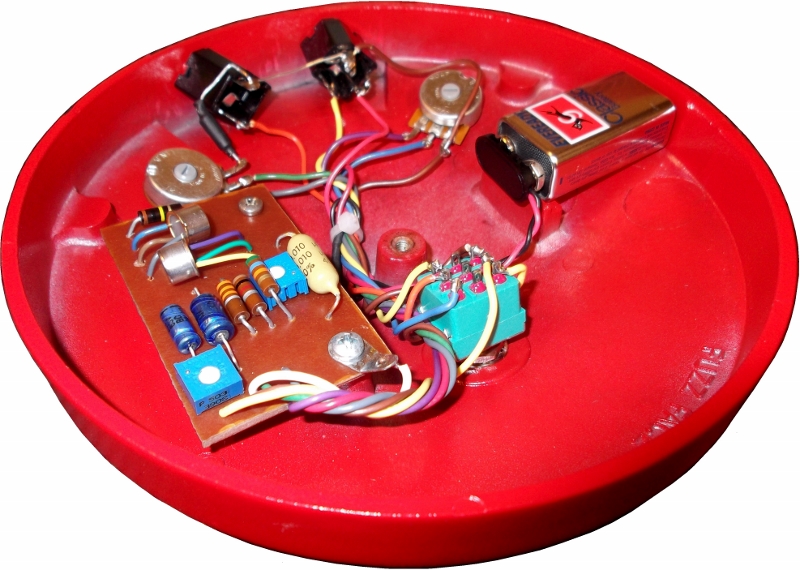 You see, the original used a Germanium chip in them. They were switched to silicon. It is said that silicon chips were more sterile and less "warm", and so for many people this seems like a crazy decision. You know who did not think it was a crazy decision? Jimi's pedal man, Roger Mayer. Roger has said in many interviews that Jimi would buy dozens of Fuzz Faces, spend a day figuring out which ones were "good" and selling or dumping the rest.
You see, when chips are made, they are made in wafers and cooked in a furnace. The chips closer to the middle are cooked differently than those closer to the walls. Germanium chips vary wildly in this aspect, and to get a consistent product, you have to spend many man hours getting them correct. The market was not large enough in the 60's to warrant that. Silicon chips are much more consistent, the placement of them in the oven does not affect them nearly as much as Germanium. So this is the reason for the switch.
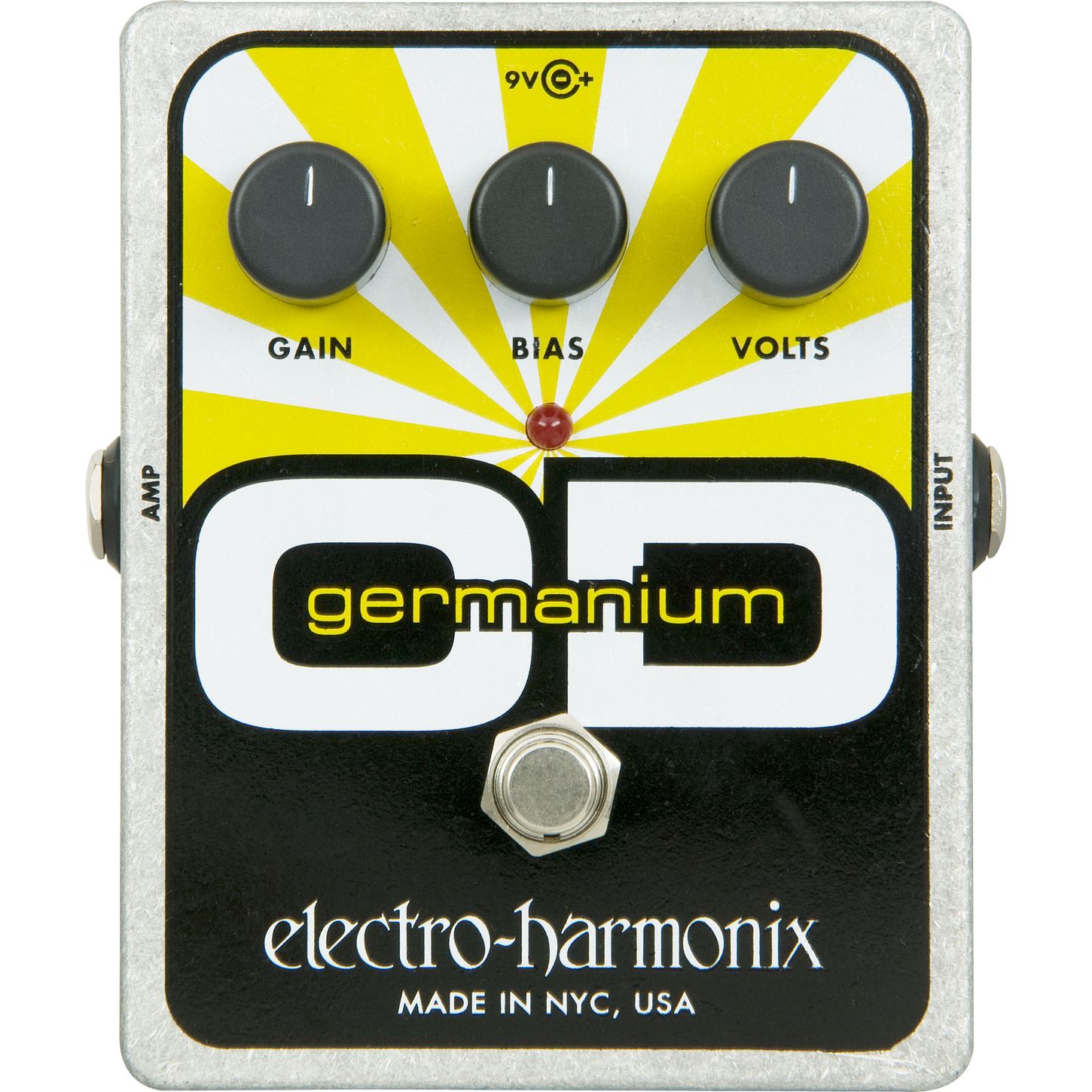 Remember this if you ever get into collecting or even buying pedals that use Germanium. You can not really base your experience on anyone else's pedal, you really should demo the pedal yourself before getting one, especially if you're going to be paying 100's on an original Fuzz Face. Big brands like Electro Harmonix claim to put in the time to find the "good" chips, but that does not mean there is going to be no variation.
Day 45
Ugh, I've got a seriously bad sore throat. It would not be so bad for practicing, but coughing so much makes my brain slosh around and gives me a headache. So I basically just practiced quiet chords and unplugged blues and rock stuff.
I did plug in to Rocksmith today though, I'm pretty sure that's a condition of the challenge lol. I had it turned down while doing my practice tracks(chords 101, 301, the Hammer on practice track) and played Guitarcade(string skip, chordead, Scale Racer). You know, you get used to playing so loud you can't really hear your own strings all that much... but nothing makes you sound like a "newb" to your own ear than doing all this stuff with the twang of an unplugged in guitar lol.
That's one of the things I figured they should have done better with in the 60 day success story adverts on Youtube. They should have recorded the sound directly and not so much with a mic near the player. I think the players were even better than they sounded because the string sound was twanging around in the background while they played, and that just messes with people's hearing and expectations.
Friday, February 7, 2014
Youtube likes and Day 43
I debated on if I wanted to do this post now or not. I have a feeling most people read these at work, so its probably a little boring to get a post of videos. Still, this is sort of a shout out to those that are helping me and do not know it, and a little bit of a "hey check these guys out" as well. These are a couple of youtube channels that are helping me.
Rob "Chappers" Chapman
His channel is probably 60% gear, 20% tips, and 20% vlog. The best thing about his channel? Watching them play. No seriously. Rob is a "metal" kind of player, and Cap-10 is a bluesy player. They play practically the same couple of licks on everything they review, and they do it on purpose so you can compare and contrast the equipment. This also means that you're learning and not even knowing it. They aren't just showing off, this stuff is pretty simple to medium in skill requirements and their channel sound is amazing.
Marty Z
Marty Z does a lot of rock and blues, but I watch him mainly for his acoustic instructionals. He's a laid back guy with good sound on his channel(this is more rare on Youtube than you'd think). I like that he not only teaches you the "correct" way of playing, he teaches you "correct" variations on playing certain songs. He's not a slave to doing it "like the artist" and I think that's an important lesson. He's good stuff, his lessons are free even though he works for a pay website, and all around is really helpful. He does a good mix of "pop" acoustic songs, but is really focused on 60's and 70's rock.
Day 43
I am quickly falling into playing Blues-rock and Metal(of the Doom/Sabbath varietal), which are two genres I really don't mind being practiced in. Thing is, I love 70's rock. So all yesterday when I practiced, I thought of 70's rock songs while playing and tried to match some phrases. I was not trying to actually copy a song, because I'm not good enough to do that yet, but at least use it to get me into the mood of playing less blues inspired rock'n'roll and more pure Rock. It resulted in a couple of new phrase recordings, so I'm quite happy about that. It is still hard as hell not to fill "space" in the practice session with blues licks. I really need to just learn some Rock licks. Still, I'm trying to focus on basics all through the 60 day challenge, and not so much learning songs... after the 60 days though... I have plans.
The "accents" lesson in Rocksmith seemed a little silly to me. Rocksmith 2014 is amazing and they obviously did a lot of great new work on it over Rocksmith. I read and watch comparisons and I really do not think Rocksmith 2013 was something I'd have stuck with. Rocksmith '14 has the session mode, much better Guitarcade, and the Riff Repeater... I can't imagine trying to learn any songs from the game without Riff Repeater. If you get 2013, just do it if you see it cheap and you want to import all the songs from it.
I would like to see some videos added for the Chord and Technique section of the game. There's this "Tool Box" section you can access that is for quick reference, so I can see why they did not do videos on most of it, but things like "tapping" and "slap and pop" techniques should at least have a link to the Lesson on them. Idealy just a quick refresher video so the player doesn't have to watch all the lesson again. Something for the next iteration. Really though, I am so extremely happy with 2014's edition. They did not just sit back and do nothing to improve it. I see now a competitor on the market that uses big names, selling them as "instructors" and presenting the songs as tabs on screen. If I had never played Rocksmith I would think Bandfuse made a lot of sense. After seeing it in action, I think that maybe the Rocksmith version of notes coming head on is a better way, but maybe I'm just used to it. Not going to turn this into a Bandfuse review/bash though. Just look at some vids if you're interested. I'd still pick up Rocksmith 2014 instead.
Rob "Chappers" Chapman
His channel is probably 60% gear, 20% tips, and 20% vlog. The best thing about his channel? Watching them play. No seriously. Rob is a "metal" kind of player, and Cap-10 is a bluesy player. They play practically the same couple of licks on everything they review, and they do it on purpose so you can compare and contrast the equipment. This also means that you're learning and not even knowing it. They aren't just showing off, this stuff is pretty simple to medium in skill requirements and their channel sound is amazing.
Marty Z
Marty Z does a lot of rock and blues, but I watch him mainly for his acoustic instructionals. He's a laid back guy with good sound on his channel(this is more rare on Youtube than you'd think). I like that he not only teaches you the "correct" way of playing, he teaches you "correct" variations on playing certain songs. He's not a slave to doing it "like the artist" and I think that's an important lesson. He's good stuff, his lessons are free even though he works for a pay website, and all around is really helpful. He does a good mix of "pop" acoustic songs, but is really focused on 60's and 70's rock.
Day 43
I am quickly falling into playing Blues-rock and Metal(of the Doom/Sabbath varietal), which are two genres I really don't mind being practiced in. Thing is, I love 70's rock. So all yesterday when I practiced, I thought of 70's rock songs while playing and tried to match some phrases. I was not trying to actually copy a song, because I'm not good enough to do that yet, but at least use it to get me into the mood of playing less blues inspired rock'n'roll and more pure Rock. It resulted in a couple of new phrase recordings, so I'm quite happy about that. It is still hard as hell not to fill "space" in the practice session with blues licks. I really need to just learn some Rock licks. Still, I'm trying to focus on basics all through the 60 day challenge, and not so much learning songs... after the 60 days though... I have plans.
The "accents" lesson in Rocksmith seemed a little silly to me. Rocksmith 2014 is amazing and they obviously did a lot of great new work on it over Rocksmith. I read and watch comparisons and I really do not think Rocksmith 2013 was something I'd have stuck with. Rocksmith '14 has the session mode, much better Guitarcade, and the Riff Repeater... I can't imagine trying to learn any songs from the game without Riff Repeater. If you get 2013, just do it if you see it cheap and you want to import all the songs from it.
I would like to see some videos added for the Chord and Technique section of the game. There's this "Tool Box" section you can access that is for quick reference, so I can see why they did not do videos on most of it, but things like "tapping" and "slap and pop" techniques should at least have a link to the Lesson on them. Idealy just a quick refresher video so the player doesn't have to watch all the lesson again. Something for the next iteration. Really though, I am so extremely happy with 2014's edition. They did not just sit back and do nothing to improve it. I see now a competitor on the market that uses big names, selling them as "instructors" and presenting the songs as tabs on screen. If I had never played Rocksmith I would think Bandfuse made a lot of sense. After seeing it in action, I think that maybe the Rocksmith version of notes coming head on is a better way, but maybe I'm just used to it. Not going to turn this into a Bandfuse review/bash though. Just look at some vids if you're interested. I'd still pick up Rocksmith 2014 instead.
Thursday, February 6, 2014
British vs American amp tone and Day 42
British and American tone
You see it practically everywhere when you are looking at instrument gear now. Digital is pervasive, and since there are a lot of "amp modeling" going on, you have to describe the amp type without using proper nouns. Even many tube amps now have a "American" and "British" switch on them to change their voicings. What exactly does it mean? Well the American amps of the late 50's and early 60's were clean sounding, while the British amps of the 60's brought in the more aggressive distortion.
The Tubes: A sort of, but not really, truth
Technical jargon ahead, skip if you want. Marshall's first amps were essentially Fender amp clones. They did not have the same tubes as Fender, but they did have similar ones that were sold surplus by the US military. Soon they switched to more locally made KT66's. By the time Jimi Hendrix was popular they were using EL34's because KT66's were becoming cost prohibitive. Fenders almost exclusively used 6L6 Tubes. The problem with this definition is that as you are aware, Marshall used 3 different tube types, and then Vox also introduced EL84! Today it is accepted that EL84 and EL34 are the "British" tubes.
The Sound You Hear
The big Marshall change to their early "Fender" clones was that they tweaked the circuitry to distort much faster than a Fender. These changes and the change of tubes essentially means that the "British" sound from a Marshall is a mid-pushed distortion that backs off on the bass and treble. This is what you will hear with your ears, no matter what the tech jumbo says. So "American" "Fender" sounds are boomy and chimey, with a smooth and light distortion. Fender clean is very clear, very precise and ringing. The "British" sound is mid-range aggressive, even the "clean" has a little bit of harmonic break up, making it described as "creamy" and "fat" and the distortion is stronger and grittier.
Not so clear Anymore
When you see "British" vs "American" you really have to think about the music of the 60's. Over half a century later, and there are amps from each side of the pond that do what the other is famous for. Mesa and Soldano amps from America have distortion in huge amounts. Vox, even in the 60's, made super clean amps in Britain that rivaled Fender. Several amps now use BOTH types of tubes and let you switch between or blend them. There are digital circuits and active equalization that can make the cleaner 6L6 tubes sound "British", and this is a common usage for them now. Marshall even uses 6L6's in their big series amps because they are more even and you can EQ them to sound "British".
Day 42
Started out today doing the Palm Mutes and Hammer On practice tracks again. It has been a while since I had done that because I was working up my skills through playing on the real amp. The Hammer On is really more a timing practice for me, I'm pretty proficient in Hammer on usage already. The Palm Mute practice track gets my speed and accuracy up. I can kind of get into a relaxed, slow chugging mood with Palm Mutes. I think Thunderkiss '66 is fast, and then I play the Practice track and realize I've got a ways to go before I"m "fast".
I keep alternating between practicing what I need to practice and practicing what I want to practice. What I need to practice is academic and building of skill. What I want to practice is all the song ideas in my head. Both help with creativity and skill, but in different amounts. I think academic basic skill building is about 70% skill building, 30% creativity. Practicing my own stuff is 30% skill building, and 70% creativity. Doing the academic gives me new skills to make more creative stuff, while doing my own stuff allows me to put my skills together in new ways, pushing me challenge my skill in ways that practice tracks just do not do.
For example: the hammer on practice track. Its a ton of hammer ons. Its me using hammer ons in specific ways at specific times, and pushing me to do them faster, more accurate, and in different combinations. However, when I play my own stuff, I'm stringing hammer ons with bends and blending them with chords. I'm saying to myself "can I do a bend, hammer on, then unbend, and slide?" At first, probably not, but later on I work on it, and yes I can.
Its a balancing act, and I tend to fall on the "practice your own stuff" side of the balance a little too much.
You see it practically everywhere when you are looking at instrument gear now. Digital is pervasive, and since there are a lot of "amp modeling" going on, you have to describe the amp type without using proper nouns. Even many tube amps now have a "American" and "British" switch on them to change their voicings. What exactly does it mean? Well the American amps of the late 50's and early 60's were clean sounding, while the British amps of the 60's brought in the more aggressive distortion.
(ACDC is a great example of pure British tone)
The Tubes: A sort of, but not really, truth
Technical jargon ahead, skip if you want. Marshall's first amps were essentially Fender amp clones. They did not have the same tubes as Fender, but they did have similar ones that were sold surplus by the US military. Soon they switched to more locally made KT66's. By the time Jimi Hendrix was popular they were using EL34's because KT66's were becoming cost prohibitive. Fenders almost exclusively used 6L6 Tubes. The problem with this definition is that as you are aware, Marshall used 3 different tube types, and then Vox also introduced EL84! Today it is accepted that EL84 and EL34 are the "British" tubes.
The Sound You Hear
The big Marshall change to their early "Fender" clones was that they tweaked the circuitry to distort much faster than a Fender. These changes and the change of tubes essentially means that the "British" sound from a Marshall is a mid-pushed distortion that backs off on the bass and treble. This is what you will hear with your ears, no matter what the tech jumbo says. So "American" "Fender" sounds are boomy and chimey, with a smooth and light distortion. Fender clean is very clear, very precise and ringing. The "British" sound is mid-range aggressive, even the "clean" has a little bit of harmonic break up, making it described as "creamy" and "fat" and the distortion is stronger and grittier.
(almost always performed with a Fender Bassman)
Not so clear Anymore
When you see "British" vs "American" you really have to think about the music of the 60's. Over half a century later, and there are amps from each side of the pond that do what the other is famous for. Mesa and Soldano amps from America have distortion in huge amounts. Vox, even in the 60's, made super clean amps in Britain that rivaled Fender. Several amps now use BOTH types of tubes and let you switch between or blend them. There are digital circuits and active equalization that can make the cleaner 6L6 tubes sound "British", and this is a common usage for them now. Marshall even uses 6L6's in their big series amps because they are more even and you can EQ them to sound "British".
Day 42
Started out today doing the Palm Mutes and Hammer On practice tracks again. It has been a while since I had done that because I was working up my skills through playing on the real amp. The Hammer On is really more a timing practice for me, I'm pretty proficient in Hammer on usage already. The Palm Mute practice track gets my speed and accuracy up. I can kind of get into a relaxed, slow chugging mood with Palm Mutes. I think Thunderkiss '66 is fast, and then I play the Practice track and realize I've got a ways to go before I"m "fast".
I keep alternating between practicing what I need to practice and practicing what I want to practice. What I need to practice is academic and building of skill. What I want to practice is all the song ideas in my head. Both help with creativity and skill, but in different amounts. I think academic basic skill building is about 70% skill building, 30% creativity. Practicing my own stuff is 30% skill building, and 70% creativity. Doing the academic gives me new skills to make more creative stuff, while doing my own stuff allows me to put my skills together in new ways, pushing me challenge my skill in ways that practice tracks just do not do.
For example: the hammer on practice track. Its a ton of hammer ons. Its me using hammer ons in specific ways at specific times, and pushing me to do them faster, more accurate, and in different combinations. However, when I play my own stuff, I'm stringing hammer ons with bends and blending them with chords. I'm saying to myself "can I do a bend, hammer on, then unbend, and slide?" At first, probably not, but later on I work on it, and yes I can.
Its a balancing act, and I tend to fall on the "practice your own stuff" side of the balance a little too much.
Wednesday, February 5, 2014
Spotlight Guitarcade: String Skip Saloon and Day 41
String Skip Saloon

String Skip Saloon is a game where you play a bartender/owner cow-girl. Bandits have decided to raid and destroy your saloon, so you have to defend it by shooting a pop-cork gun at them to knock them out. Each "lane" of bandits is a string on your guitar. You pluck/pick/play the string to make the cow-girl fire in that lane.
 This game is a take on a game I had never known about or played until a little over a year ago. It is called "Tapper" and the reason I know about it is because it was the video game character bar in Wreck-it-Ralph. In that game you pour and sling beer down the counter tops to the awaiting cowboys. The sounds are very period correct, and the game is almost exactly what you'd expect from a game inspired by Tapper.
Changes I'd make? I'd allow the strings to be switched for JUST this game, instead of having to switch them for all the lessons and songs as well.
Day 41
I have said before that because of my written word habits, I record just about anything interesting I might not remember later. I came across one of the recordings when I was practicing power chords. It was a clean recording, but there was a part where I continued through the chord into a sort of lead phrase and it sounded great... I stopped for some reason and didn't continue and went back to the chords. I could not remember how I played what was recorded there, but it caused me to get to experimenting.
I'm working on moving in and out of chords while playing some lead. I'm trying to get it all to sound like it all fits. I know a lot of it is timing, but it is also getting the phrase right in the amount of time before you have to go back to the chord so that you don't sound like you put a halt on the song. At least, that's what is going through my mind as I work on and try to get it working right. Its much easier to do when playing some chugging metal, because the distortion will carry you through. With a clean sound, its much harder, and so that's what I've been focusing on. The more I get into chords, the more I want an acoustic. Rocksmith has an acoustic modeling amp, so that's a help.
Once again, and I can't emphasize this enough, Power Chords are wonderful for practicing this. Don't turn your nose at them. I can go back and forth to them easily, and it really gets my confidence up. Once you're physically prepared for this kind of play, you can then move on to using other types of chords. They can easily be stepping stones, and they sound great and that's encouraging. They help me and so I can only assume they'd help you.
I guess I have not had a huge "break through" in a while, and I'm not sure if this is good reading or not. Playing both rhythm and lead in the same song might not be an epiphany but it is a real skill I'm practicing along with chords. My pieces are getting better though. My phrases are matching up and I'm sure what I play can be confused as music.
Tuesday, February 4, 2014
Pick your Pick and Day 40
I'll get this out of the way first; the only advice you can really give about picks is to try them out and figure out which you like best. Picks are like 25 cents, and you're going to wear a pick down and have to replace it eventually, so why not just get a few and test them out.
Other advice:
Thick, hard picks give you a very strong attack on the string. They are less flexible but make a harder hit on the strings. Many people that play more "lead" guitar, note for note playing as opposed to chords, prefer to use a stiff pick. These picks will also tend to wear out faster if you use it for a lot of strumming.

Thinner picks are more flexible. They are easier to move from string to string in a sweeping motion, so these are very adaptable to chord playing. They are made to be flexible, so they wear out slower when it comes to strumming. When it comes to note per note playing, they can actually slow you down a bit. However more the pick has to be flexed to get past a string, the more effort it takes to strike the chord. We're talking milliseconds here, but "feel" is subjective.
I personally like a .88 pick. It would be considered a little bit more stiff than the "medium" side of the spectrum. The lightest I can stand is a Fender Medium, I do not even like them very much for strumming. I have a 1.14 pick that is too stiff for me. They make some that are 3x as thick as that, they are so thick that they generally have a ground out "grip" on them so you don't feel like you're holding a brick.
I've seen videos of people using STONE or GLASS picks. These have zero flex to them. I would consider this extreme, but Brian May from Queen uses a coin that is just a tad bit bigger than a US dime. Billy Gibbons from ZZ top uses a Mexican peso. Some like Celluloid picks because of their flexibility and the traditional feel of them, but there is also tortex. Tortex is a rougher plastic that provides a little more grip, this is my material of choice. If you need even more grip there are specially treated picks with a rubberized surface to them.
Like I said at the start, you just need to try them out to figure out what you like. Don't be afraid, they usually aren't expensive, and you'll lose many of them before they wear out anyway. You don't have to be different, and you might want to worry about your strings before you go using a coin. Work your way progressively towards the ends that you're comfortable with. I plan on keeping some Fender cel mediums along with my tortex .88's. Some times you just feel like a change.
Day 40
I've had too many silent(unpowered) nights of practicing chords. Today I tried out my new amp set up. I've got my amp elevated, so I've lost some of the low end in the sound. I have cranked up the bass settings, but ended up just having to take the amp down to the floor when I was doing my metal practice. I just have to "feel" those palm mutes. If you keep your practice amp on a table, take that into consideration; you're losing low end.
I am fuzz-strated. I can't get a fuzz in Rocksmith to sound like I want AND I can't get a fuzz sound from my multi-effects pedal into my real amp. I guess that fuzz is just too hard to do digitally modeled? I don't know. I did put a high gain amp model into the dirty channel on my Marshall, and got an acceptable, but overly complicated Fuzz. I want a Devi Ever Soda-meiser so very badly.
I finally recorded some of my heavy metal "phrases" I've come up with. A few days ago I was going to play some for my girlfriend and my mind just went blank on the stuff. Playing in front of someone messes with your memory I guess. Anyway, I have recordings of a few of them now so I can just bring that up on my phone and job my memory. For some reason I kept wanted to make it more "swinging" sounding in the beat.
Other advice:
Thick, hard picks give you a very strong attack on the string. They are less flexible but make a harder hit on the strings. Many people that play more "lead" guitar, note for note playing as opposed to chords, prefer to use a stiff pick. These picks will also tend to wear out faster if you use it for a lot of strumming.

Thinner picks are more flexible. They are easier to move from string to string in a sweeping motion, so these are very adaptable to chord playing. They are made to be flexible, so they wear out slower when it comes to strumming. When it comes to note per note playing, they can actually slow you down a bit. However more the pick has to be flexed to get past a string, the more effort it takes to strike the chord. We're talking milliseconds here, but "feel" is subjective.
I personally like a .88 pick. It would be considered a little bit more stiff than the "medium" side of the spectrum. The lightest I can stand is a Fender Medium, I do not even like them very much for strumming. I have a 1.14 pick that is too stiff for me. They make some that are 3x as thick as that, they are so thick that they generally have a ground out "grip" on them so you don't feel like you're holding a brick.
I've seen videos of people using STONE or GLASS picks. These have zero flex to them. I would consider this extreme, but Brian May from Queen uses a coin that is just a tad bit bigger than a US dime. Billy Gibbons from ZZ top uses a Mexican peso. Some like Celluloid picks because of their flexibility and the traditional feel of them, but there is also tortex. Tortex is a rougher plastic that provides a little more grip, this is my material of choice. If you need even more grip there are specially treated picks with a rubberized surface to them.
Like I said at the start, you just need to try them out to figure out what you like. Don't be afraid, they usually aren't expensive, and you'll lose many of them before they wear out anyway. You don't have to be different, and you might want to worry about your strings before you go using a coin. Work your way progressively towards the ends that you're comfortable with. I plan on keeping some Fender cel mediums along with my tortex .88's. Some times you just feel like a change.
Day 40
I've had too many silent(unpowered) nights of practicing chords. Today I tried out my new amp set up. I've got my amp elevated, so I've lost some of the low end in the sound. I have cranked up the bass settings, but ended up just having to take the amp down to the floor when I was doing my metal practice. I just have to "feel" those palm mutes. If you keep your practice amp on a table, take that into consideration; you're losing low end.
I am fuzz-strated. I can't get a fuzz in Rocksmith to sound like I want AND I can't get a fuzz sound from my multi-effects pedal into my real amp. I guess that fuzz is just too hard to do digitally modeled? I don't know. I did put a high gain amp model into the dirty channel on my Marshall, and got an acceptable, but overly complicated Fuzz. I want a Devi Ever Soda-meiser so very badly.
I finally recorded some of my heavy metal "phrases" I've come up with. A few days ago I was going to play some for my girlfriend and my mind just went blank on the stuff. Playing in front of someone messes with your memory I guess. Anyway, I have recordings of a few of them now so I can just bring that up on my phone and job my memory. For some reason I kept wanted to make it more "swinging" sounding in the beat.
Monday, February 3, 2014
Kompressor and Day 39

That is what is known as a Ross Compressor, and it is probably the most copied pedal of modern time. Ross was a company owned by Kustom. The company MXR had come out with a Dynacomp based on an earlier design, so Ross decided to try their hand at that as well. Because of this, the two most common compressors are very closely related, but since Ross went out of business, it is the most copied.
From Chinese makers like Biyang, to big name makers like Wampler, the design pervades the market. Guyatone, BBE, Behringer, Modtone, even MXR(their Super Comp) does a copy of it. I have read on so many pedal review blogs that when the reviewer gets a new compressor, they check to see if its just a Ross clone, and then chunk the thing. Frequently I see "Ross clone, refer to this link for a review of another Ross clone", because they pretty much all do the same thing, but may add dry blend, tone shift, etc.
Compression is a subtle effect, and the differences between them are largely based on their circuit design. There's a lot of "if you can't hear it, then you just need to train your ear" kind of stuff going on with compressor voodoo. Essentially it makes the sound more even, your subtle sounds come up in volume, and your loud peaks go down in volume so that everything is evened out. It is very easy to pull the wool over the eyes of people with a compressor.
Just do yourself a favor, and before you go out and spend 250 bucks on a boutique compressor, find out if its a Ross clone. Ross' have 2 knobs and the circuit. If you're paying 180 bucks extra, find out WHY its 180 bucks extra. is it the fancy paint job? The clever pedal name? Or have they added things like blend knobs so they are usable with bass guitar, or done things like double the circuit, or add muliple types of compression. There is no reason you can't get a studio quality Ross clone for 70 bucks.
*bonus
Other compressor designs include optical that uses photo sensors and light pulses to create compression. Some, like Electro Harmonix, make designs that use pre-amp tubes to compress the sound. Both of these types can be more expensive, not because of the fancy name, paint job, and pedal maker pedigree, but because the components are complex and expensive. Many bassists like the optical compressors because they are "transparent" meaning you do not lose a lot of bass, unlike the Ross clones. If you want a Ross clone that works for bass and guitar(to simplify your life), get one with a dry signal blend so you can blend your bass back into the signal.
Day 39
Early morning and late night practicing. My Sunday practices just don't settle on a regular course. This was mainly due to the fact I got my practice area set up. I also pulled the bass guitar out and took my old friend for spin. Poor thing was feeling neglected. I've got my bass and guitar amp in an easy to use and operate area now, so they'll both get a work out. I'll try not to talk so much about the bass stuff during this Rocksmith thing. I am thinking of taking the 60 day challenge for bass later this year, after I get on my feet with guitar. It will be interesting as I find most rock bass to be boring, and I'm no where near the noob I was with guitar.
Funk funk funk. I am wearing out my wrist with these funk strumming patterns. To try and put it in perspective, count to 4. Now in the same amount of time as you just counted to for, count to 8. Yep, twice as fast. Now, in the same space that you counted to 4, count to 16. There ya go. Funk is a lot of 16th notes, which means compared to many blues-rock bar room songs, you're doing 4x the amount of notes. Well, that's technically right, but not 100% right. Anyway, that's some muscles to get conditioned.
The "most accurate" way of playing Simple Man is to have a walk up to the C chord in it. Listen to the real song and you can hear the "walk up" to it. This really sucks for me. See, I realized that an A minor chord only needs one finger to move to become a C major chord. I have gotten use to starting off in that A minor shape and moving that finger instead of stuff making a C major. This has screwed me for doing that walk up in the song. So time to re-learn C major from scratch and get out of that habit.
Subscribe to:
Posts (Atom)