Showing posts with label Metal. Show all posts

Thursday, February 13, 2014

Metal not lmletal and day 49


The problem of volume has always been with the guitar.  Earlier strings instruments used bows and could have giant bodies to provide immense volumes.  Eventually the body would get so large that you got out of the guitar's sound pocket and you'd be playing Bass.  Any form of making a guitar larger ended up being more like larger string instruments like the Harp or the piano.  This was all solved by electrical amplification in the 20th century, but right before that revolution an amazingly cool guitar style was invented.

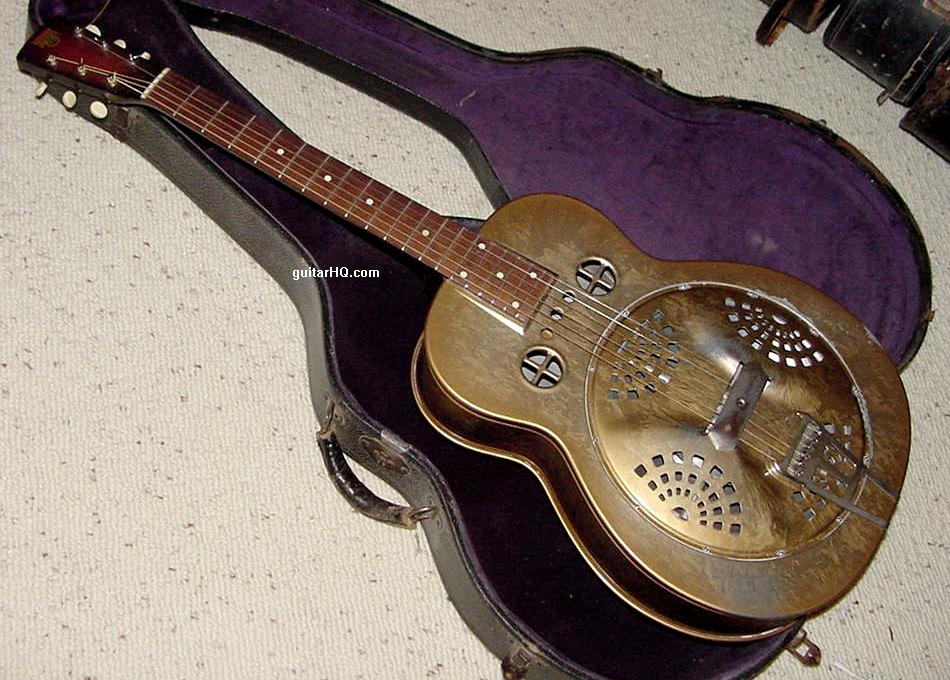
Resonators are guitars designed to work with metal parts to create a strong reflection of sound back to the audience.  The sound was certainly louder than many acoustics of the time, but the metal really did give it a unique sound that did not work with most types of music at the time.  Resonators became cheap, and easier to move around than having your own electrical PA system.  The more "rural" types of music adopted these "outdated" instruments, and due to the sheer amount of usage they got in Bluegrass and blues, they are now accepted as mainstay sounds of those genre.

Resonators have metal bowls and reflectors, known as "Cones" built under the strings to take the sound and reflect it back out into the audience.  The originals used a 3 cone design, but a split in the company lead to a simpler and cheaper "dobro" design using a single cone.  Further, you could get square necked resonators to play like a steel lap guitar, or the round neck variety to play more like a traditional guitar.  Both are popular with slide guitar techniques.

Resonators, to me, rank as some of the most beautiful instruments ever created.  There are entire guitars manufactured out of bell brass and engraved with patterns and designs that remind me of the dualing pistols of the 17th century.  There are just as beautiful wood and metal combos that look like something out of a junk yard, but sound amazing.


Day 49

Still snowed in, but my hearth is still warmed by the awesomely burning light of ROCK.

or something Jack Black would say.... or maybe I'm watching too much Gearmanndude.  Wait, same person aren't they?  Has that myth been busted?  I refuse to accept it.

Anyway.  Somehow in between all the metal and rock, I came up with a very poppy guitar track.  Sounds a bit like "Steady as She Goes" now that I sit here and think about it, but I think that I was channeling Nirvana's Nevermind when I was doing it.  It is poppy, and its sorta happy sounding, but don't hold that against it, its fun to play!  I swear.  I'm really jonesing for a fuzz pedal these days.  Its quickly looking like 70's rock may give way to some 90's alternative soon.

So I'm practicing Stranglehold and while looking at my "recommended" tab, there was Black Betty.  Wow, it looks "doable" for me as well.  Black Betty just has so much energy, I figured I wasn't ready for it, but I think with practice I can get it pretty quickly.  It all goes back to my power chords having a lot more definition and sound to them.  As I said before, they're becoming less punk and more 70's rock, and that's evident with the two new songs I'm practicing on.  Black Betty has also been in my head because of Rayman Legends.  There's a level on that where the bad guys play Black Betty while you bowl through them running from some monstrosity or another, and its highly entertaining.


Tuesday, February 4, 2014

Pick your Pick and Day 40

I'll get this out of the way first; the only advice you can really give about picks is to try them out and figure out which you like best.  Picks are like 25 cents, and you're going to wear a pick down and have to replace it eventually, so why not just get a few and test them out.

Other advice:

Thick, hard picks give you a very strong attack on the string.  They are less flexible but make a harder hit on the strings.  Many people that play more "lead" guitar, note for note playing as opposed to chords, prefer to use a stiff pick.  These picks will also tend to wear out faster if you use it for a lot of strumming.

Thinner picks are more flexible.  They are easier to move from string to string in a sweeping motion, so these are very adaptable to chord playing.  They are made to be flexible, so they wear out slower when it comes to strumming.  When it comes to note per note playing, they can actually slow you down a bit.  However more the pick has to be flexed to get past a string, the more effort it takes to strike the chord.  We're talking milliseconds here, but "feel" is subjective.

I personally like a .88 pick.  It would be considered a little bit more stiff than the "medium" side of the spectrum.  The lightest I can stand is a Fender Medium, I do not even like them very much for strumming.  I have a 1.14 pick that is too stiff for me.  They make some that are 3x as thick as that, they are so thick that they generally have a ground out "grip" on them so you don't feel like you're holding a brick.

I've seen videos of people using STONE or GLASS picks.  These have zero flex to them.  I would consider this extreme, but Brian May from Queen uses a coin that is just a tad bit bigger than a US dime.  Billy Gibbons from ZZ top uses a Mexican peso.  Some like Celluloid picks because of their flexibility and the traditional feel of them, but there is also tortex.  Tortex is a rougher plastic that provides a little more grip, this is my material of choice.  If you need even more grip there are specially treated picks with a rubberized surface to them.

Like I said at the start, you just need to try them out to figure out what you like.  Don't be afraid, they usually aren't expensive, and you'll lose many of them before they wear out anyway.  You don't have to be different, and you might want to worry about your strings before you go using a coin.  Work your way progressively towards the ends that you're comfortable with.  I plan on keeping some Fender cel mediums along with my tortex .88's.  Some times you just feel like a change.

Day 40

I've had too many silent(unpowered) nights of practicing chords.  Today I tried out my new amp set up.  I've got my amp elevated, so I've lost some of the low end in the sound.  I have cranked up the bass settings, but ended up just having to take the amp down to the floor when I was doing my metal practice.  I just have to "feel" those palm mutes.  If you keep your practice amp on a table, take that into consideration; you're losing low end.

I am fuzz-strated.  I can't get a fuzz in Rocksmith to sound like I want AND I can't get a fuzz sound from my multi-effects pedal into my real amp.  I guess that fuzz is just too hard to do digitally modeled?  I don't know.  I did put a high gain amp model into the dirty channel on my Marshall, and got an acceptable, but overly complicated Fuzz.  I want a Devi Ever Soda-meiser so very badly.

I finally recorded some of my heavy metal "phrases" I've come up with.  A few days ago I was going to play some for my girlfriend and my mind just went blank on the stuff.  Playing in front of someone messes with your memory I guess.  Anyway, I have recordings of a few of them now so I can just bring that up on my phone and job my memory.  For some reason I kept wanted to make it more "swinging" sounding in the beat.

Thursday, January 30, 2014

Requests and Day 35

"Play something you've come up with"

That's what every newer guitarist would want to hear.  The reality is that when you sit down to show someone that you're learning guitar, they instinctively want to hear something they recognize.  Its only human nature, they want to compare you to something they've heard to be able to judge your skill.  If you can play something they perceive as a good song, they're going to think "oh wow, my friend can play this popular song!".  I'm guilty of it as well.  I used to ask "can you play Sweet Child of Mine" and in the later years, "know any Pantera?"

I've been on the other side now though, and I regret being that way.  When you're new and you're learning, you're focusing on technique and practicing.  In all reality, you probably know some pretty good sounding things to play that uses the techniques you know, but you might be missing one technique to be able to play ACDC, or Guns N Roses.

You also might know a few genres.  You might be tempted to say, "well I can't play that, but if you tell me a genre of music you like, maybe I can play something in it for you in that style".  Seems like 90% of the time they're going to say "I like J-pop" or "know any Skrillex?", or something equally as un-guitar or something you just don't know the style of.

That's just how life goes.

So if you're reading this, and you have a friend that is practicing and learning guitar, remember what I've said.  There are 10 million-billion songs out there, and chances are your first 20 you can come up with aren't going to be something they can play.  Look at them, smile a little bit, and say "just play something you know or something you've come up with yourself".  You're going to hear something new, don't be scared, you might be the first person ever to hear a new piece of music that never existed in the world before.  It could be great.


Day 35

I have pretty much decided on 4 "tone" categories that I like to play in.  Clean for acoustic/chords work, light overdrive for bluesy stuff, British Crunch(my favorite) for ACDC sounding rock, and high gain "High on Fire" tone for metal.  Today I played with the Tone shaping section to try and get two of these:  high gain metal and low gain overdrive.

I have to say that low gain overdrive is the hardest to get "right" with the sound in my head.  I think that's why there was so much fuss over the Tubescreamer pedals that Stevie Ray Vaughn popularized.  He sort of gave everyone a "base" to start from.  There's a billion tubescreamer clones and light overdrive circuits in the pedal world.  Am I happy with what I"ve done in Rocksmith to get the sound?  I'm about 75% happy.  I would like my natural tone to get out a little bit more, but none of the low gain pedals have a mix built in to run a dry signal through.  I may have to go to the regular drive category and just really roll off the drive.  My real Marshall amp does not do this sound very well, I need to break out my amp modeler and test out some stuff.

I am about 90% satisfied with my high gain metal tone I have though.  I looked up Matt Pike's amps and found that there might be a clone of it in Rocksmith.  So I chose that amp, maxed the gain, and then put a high gain distortion pedal in front to boost it even more.  Its pretty awesome sounding metal bliss.  There's a lot of Matt Pike inspired metal guitarists out there these days, so I can cover a lot of ground with his sound.  Take away some bass in the signal and you can get a lot of Mastodon's sounds, for example.  I'm not a squeally diddly diddly dealeo doo kind of metal fan.  I'm more of the Black Sabbath heavy riff kind of metal fan, and Matt's tone is sort of an Iommi on steroids kind of sound.

Wednesday, January 29, 2014

Wahhhhhh and Day 34

The Wah, the Auto-Wah, and the Envelope Filter.


These are some of my favorite filters for just having "fun" with.  If you are new to instruments, you can sound like you know what you're doing if you have one of these to play with.  Its the funk "wick wicka wick wah" sound, the "bow chicka wow wow" sound.  To the new, they all seem the same, but to someone presented with the 3, it becomes a little more clear.  So here's what they are, and consequentially the differences.

First off I should talk about the origins.  The origins in modern music is thought to be traced back to the 20's and 30's when horn players learned they could manipulate the horn mute in and out to create a "wah" kind of vocal sound to their playing.  Later this was reproduced in electronics in the form of a Wah Pedal, later came the envelope filters.  Sitars are known to be able to make this type of sound too, but the influence in modern rock is from the horn players.

A wah-pedal is a filter that let's you change the filter's "Peak" by using your foot.  Where the peak is determines where the sound gets highest or lowest in the signal modulation.  You can hear it very noticeably in Jimi Hendrix's "Voodoo Child(slight return)".  The Wah-pedal makes every performance a unique experience, with slight changes in how much the player uses the pedal affecting how the song sounds.  The performance is not standardized, but there's much more "expression" from the player.

(video above is my favorite pedal of any type for any instrument of all time, the Bass IQ from EBS)

Technically an Auto-wah is an Envelope Filter.  A pedal uses an Envelope follower to create a voltage from the volume signal of the guitar.  This volume signal changes the peak of the modulation of the signal.  The difference is that an Auto-wah typically stays set at a fixed position that you choose and creates a much more consistent sound.  This is useful for recording or freeing the player from having to manipulate a pedal and focus on playing.  The notes will always trigger the auto-wah at the same spot and make the same sound.  What is typically known as an Envelope Filter allows the intensity of your playing to alter the sweep.  If you play lightly, you sweep slower, lower, longer and softer.  If you play hard, you'll trigger the sound to make a fast, quick, snappy and short sweeping sound.  It brings in the "expression" from a wah pedal, but frees the player from having to mess with a pedal just like an auto-wah.

I am a huge fan of Envelope Filters on bass guitar, though my enthusiasm for wah of all types on guitar is growing.

Day 34

Wow.  Some days.  Some times there's like this thing in the air.  Your state of mind, the atmosphere, the guitar is tuned just right or the knobs on the amp are tweaked to some kind of point... Today I had the most metal practice session ever.  Like, I would not mind playing in front of some people kind of playing.  I needed extra arms to make the lml etal horns while I played.  I was playing so metal, I am pretty sure that I accidentally bumped into actual parts of Black Sabbath songs.  I would look up those parts to see how close I was to them, but then I'd be so excited I'd play 3 more hours and I just can't do that right now lol.

Its snowing outside, and I'm pretty sure I was playing the Viking raiding anthem.  I dare not entice them more.

The ironic thing is, I was like "ok, today I'm mastering the next tier of "Simple kind of man".  A song that is decidedly un-metal.  I just don't know what got into me, but I kinda wished it did so more often.  Anyway, I have began noticing people playing chords that I know while watching TV, movies or youtube.  Now I'm starting to recognize when people are playing a bunch of power chords.  I was watching some really good pedal demos today, demos done by the people that make the pedals, and they sounded really good and all they did was play power chords.  I experimented with power chords which lead to my metal practice today.

I know there's a hipster sort of thing going on and has been for a long while, where if someone is playing a lot of power chords, some smart ass says "pfft, they're just playing a bunch of power chords" and frequently its by people that a power chord is just about the only term outside of "note" that they know.  Come on.  People are better than that.  Music is music.  Do not become a snob of technique, because let me tell you, unless you're Bucket Head, Joe Satch or Malmsteen, there's always going to be someone that can put your skill to shame.

Appreciate the simple and complex.

And never be ashamed of the music you make(I need to listen to this advice myself).

Tuesday, January 14, 2014

Play what you like, even if you don't like it. And Day 19

Forgive me if I've ever given you this "speech" already.

I did not consider myself a "bassist" until I had this strange set of revelations.  One of these revelations was that I should embrace what I find fun to play.

I know that seems weird, but I have to explain a little.  I'm probably notorious around my friends were hating radio.  I really can't wait for 2 or 3 songs that I don't care for to get done for 1 tolerable song.  This means that it is hard for me to focus on learning any songs I find blah.  This also means I don't like playing "blah" bass lines that exist in a lot of classic Rock or the genres I listen the most to.  Its my flaw, I know I suck more because of it, but I try to live with it.

About 6 years ago I was turned on to "jazz improv" bass by the Talkbass forums.  I have to tell you, I can't sit and listen to this stuff really... but holy crap do I love to play it.  How can I explain that without sounding like a jerk?  Maybe its like the people that will play sports, but hate watching it on TV?  Maybe it reminds them that they should be doing it rather than watching it?  I do make myself sit and listen though, for learning reasons.  It has probably made me what people would call a "busy" bass player.

I read that John Paul Jones used to listen to horn players and that's how he got inspired for his bass lines in Led Zeppelin.  So I immediately got on Youtube and looked up the horn player I knew the name of, Louis Armstrong.   I also branched out.  The silly thing was, I forgot to go back and listen to more Led Zeppelin.  This came later with another "revelation" I will write about later.  By listening to that, I began appreciating the older "golden era" of horn player's music.  I also became a much better bass player, and learned a very clean, "poppy" sound as I tried to come closer to the sounds I heard on the jazz.

Anyways, all of that is to say, play what you find fun.  Sure, you've probably heard it, and you've probably thought "well yea, play what you like not what other people like" and I say YES BUT, maybe you find something fun that you don't like.  Play to your strengths.  You may love Punk rock, but you find you hate the bass lines.  You may despise Surfer music, but find tremolo picking to be tons of fun.  Play what is strong for you and it will make you practice more, and eventually you can work your style into the genres you like.

John Paul Jones works his motown inspired stuff into the heaviest rock that Led Zeppelin does.  Flea brought funk bass into punk rock.  Brent Hinds of metal band Mastodon is a bluegrass banjo player.  I have, on several occasions, brought my improv jazz into blues.  I am currently bringing the only thing I really know decently on guitar, simple blues riffs, into chugging palm muted metal.  Play what you find fun, play what is strong for you in technique, and then YOU can make it the genre you wish you were playing.  You may find your own voice and bring something new to the world.

Day 19

I'm not going to lie, I did not get a lot of playing in today.  I had jury duty and after I got home, I took a nap.  I used the guitar unplugged for about 30 minutes, noodling as I waited for lunch to get cooked.  Practiced the stuff I've been practicing lately.  I did play 1 game each of my "warm up" Guitarcade games.  I also played some of the Scale Racer.  I love the look of Scale Racer.  It reminds me of Rad Racer, a game I played a  lot in my youth.  Scale Racer is the kind of game that is going to help me learn scales.  I wanted Scale Warriors to help so badly, but I'm more focused on getting the "game" correct than learning anything.

I did get some practice in though, so I count that as a triumph.  You can take it as you will.

Monday, January 13, 2014

Legendary: Brian's Guitar and day 18

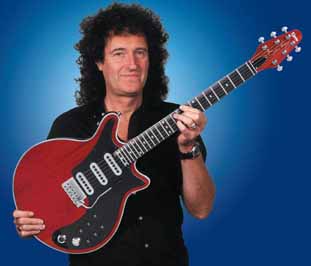
Brian May is the guitarist for Queen, and one of the greatest rock legends.


In 1963 though, he was just a kid with almost no money.  What he did have, though, was a father that was willing to help his son achieve his dreams.  Brian and his father scoured the neighborhood for materials.  Someone that lived near them was throwing away an old 18th century fireplace mantle, made of mahogany.  It was worm ridden in some places, but they were able to shape a neck out of it.  Next they planed some oak to be a fret board.  The inlays are mother of pearl buttons they collected.  The body is semi-hollow, being made of oak with a thin sheet of mahogany for the top.  Next he made a tremolo with a knife and some motorcycle springs.  He then found some old shelving plastic and used it to "binding" material, the outline around the body that is popular on Les Pauls.

He bought some pickups, but rewound them himself.  He also sealed their pots to protect the pickups from microphonic feedback.  This was important because he wanted to include a way to cause feedback on purpose.  His dad had enough electrical engineering know-how to help him achieve this.  He could then induce it at a whim, instead of walking in front of the speaker hand hoping it worked like Clapton and Hendrix did.  I personally did not know his guitar could do this, but now it makes so much sense.  There's this part in the solo of "We Will Rock You" that I used to characterize as "the guitar coming back and eating itself", but now that I am older, I realize its the self induced feedback that he designed to be in the guitar.  Its genius.

It took him and his father  two years to make the guitar, and now its given the world 40+ years of pure, epic, awesome rock.  The guitar now is a legend, and has been named "The Red Special".

I referenced BrianMayGuitars.co.uk to make sure I got the details right, and claim no ownership of the story.


Day 18

Today was a Sunday, so that means I had an audience while practicing.  I still have a lot of work to do on making Everlong sound really nice, and it is very hard to do an arrangement all by yourself without having a way of switching from clean to distortion.  Which, I can do do with my real amp, but the game amp not so much.  During "Learn-a-song" it will change automatically for you, as if you have a road crew.  No such luck in real life.

My girlfriend played some more of her favorite games and then shocked me with playing Smoke on the Water :)  I thought she had learned that in school band, but she said she once had an acoustic.  She had never gotten to play around on a electric with some nice distortion to it, so she had a lot of fun.  I have several times thought about buying an extra guitar to keep at her place so I could practice over there.  When I have the money, I think I'll need to get a practice amp so she can play the guitar whenever she wants to as well.  She has no PS3, so I can't loan her Rocksmith.

I loaded up a metal band in session mode, the "classic" one, I can't remember what its called right now as I type.  Just a week ago I had listened to it, and just could not achieve any type of mellowness with the band they presented.  Now, though, with palm muting, I feel like I can at least jam with a metal band.  Speaking of Palm Muting, I have heard of people using palm muting on acoustic before, but my mind just could not wrap around what or why people would do it.  I decided, since Sundays are kinda crazy anyway, to load up an acoustic simulator and see how it sounded.  I then played bayou, cajun sounding music for about 20 minutes.  That's the sound palm muting on an acoustic does.  Cajun blues.  My repertoire of genres is increasing 

Almost 1/3rd through the 60 day challenge, and I am very happy with my Rocksmith experience, I've learned things that even if I stopped using Rocksmith today, would be skills for playing guitar that I'd use the rest of my life.