Showing posts with label Pentatonic. Show all posts

Wednesday, February 26, 2014

The Flute; Expanded


I was watching Cave of Forgotten Dreams last night, when the talk changed from cave drawings to paleolithic tools.  This was when I first found out about paleolithic flutes, and particularly the oldest one ever found.  The flute was carved from vulture bone, and was also found in the workshop of some paleolithic Da Vinci.  Carbon dating all the tools and pieces of art in the are gives evidence that the flute is 40,000 years old.

Made by a Master

The flute itself is a 5 hole flute.  The cool thing about this flute is that it is not only the oldest undisputed flute as of the movie, it is not just a simple hollow tube with holes.  This flute was the making of an artisan.  There are notches all along the sides.  The reason for this is that the bone was cut in half, long ways, and hollowed out using stone tools.  This, using the notches as a guide, the two pieces were put back together and sealed with an air tight sealant, perhaps a primitive animal glue.

The Sound

The flute was created with only the thought to sound pleasing to the ear of the maker.  The 5 holes do have markings, but it is believed these markings are just guidelines from the artisan, rather than a "known" system of flute making.  The closest approximation to modern instruments is that it is a Pentatonic based note pattern, instead of a chromatic or diatonic flute.

Some Time

To put this in perspective for myself, I looked up a few known facts about something made so far back.  When this flute was made, there were lots of animals that no longer roam the Earth.  The big cats; Sabertooth tigers and Cave Lion, were still alive and well known to the maker.  Tribes related to the maker would soon make cave drawings of Woolly Mammoths and Cave Bears.  The world certainly did not look the same, as the English Channel was a barren, dry piece of land because there were glaciers over the alps that were many thousands of feet thick.  The flute is twice as old as potter, thirty thousand years older than the oldest known bow, and it goes without saying that it pre-dates written languages, walled cities, and when this flute was made wheat was nothing but a wild grass.

Audience

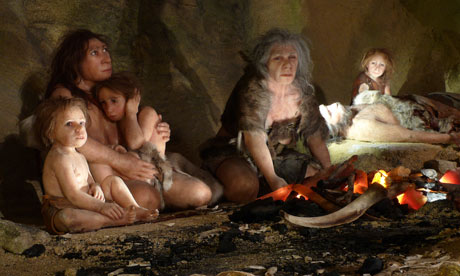
Another animal that was still around when this flute was made was the Neanderthal.  It is virtually impossible that Neanderthal man did not have contact with homo sapiens of this era.  We can only speculate if it was peaceful or horrendous.  There is possibility that Neanderthals have heard us make our music with our instruments.  It is impossible for us to know if Neanderthals had their own music, but evidence suggests that if they did, it was voice or percussion based.  One of the distinguishing features of Humans is that our paleolithic sites have tools and art created out of bone, while Neanderthals have no such trinkets at their sites.  Therefore, one of the distinguishing features of modern humans compared to the neanderthals that died out is that we have complex music, and they did not.

Using tools to make music is a heritage of all humanity.

Thursday, February 20, 2014

The Perfect Circle and Day 56

Getting a little nerdy here, but maybe you'll find it interesting.  The first part might look like a text book, but keep going.

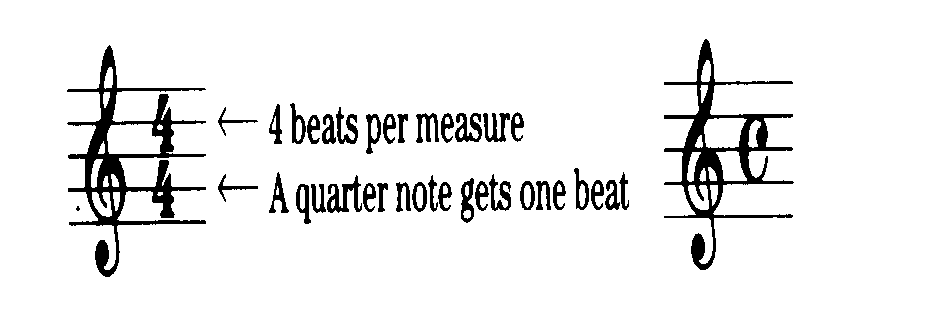
Most western music is separated into a measure.  This is a musical unit that transcends all instruments.  When written down, you see a fraction used to help tell you how to play the piece of music.  The most common notation is 4/4, and it is called "common time signature".  It is literally the most common found.  From blues rock, to pop music, 4/4 is found all over the place.  On paper it looks like this:


What the numbers mean is pretty easy, and this isn't really an educational post.  The first or "top" number is the number of beats in the measure, and the bottom number is the length of the notes.  This means 4/4 means 4 quarter notes used in each bar.  Don't dwell on that too much.  What we're looking at today is the C that is written there.

Well, 4/4 time is known as several things.  The term "Common Time" is a more recent one that has come over time.  Many people think that the "C" there is for common time, but the notation is older than this name.  The "C" came many many years before the fact that 4/4 emerged as the most common.  We need clues.  Well 4/4 is also known as "Quadruple Meter".  That one is simple... maybe not any help to us.  It is also called "Imperfect Time".  Oh, hey, there we go.  Imperfect time.  If 4/4 is imperfect, what is "Perfect".  The time signature of 3/4 is "Perfect Time".  But why?  Well what changed.  There's a 3 in there.


When all this notation was being created, much of it was for religious usage.  The bulk of higher educational music was being done by the Church for their choirs.  Is there any Christian religious significance to the number 3?  The Holy Trinity.  This is why it is considered perfect, it is a holy number.  To Christians perhaps the holiest number.  The problem is that there are so many numbers used in notation, it could be confusing, so they needed another symbol for "perfect".

That's where the "Perfect" circle comes from.  A circle is a continuous line going on forever, unchanging, and perfect.  So 4/4 timing is not so perfect, its "Imperfect", but its close.  How do we show that something is "Imperfect".  How about a broken circle?  That's right!  The C used to represent 4/4 timing is not a "C" at all, so it can not stand for Common Timing.  It was originally a broken circle to stand for Imperfect Timing.

Day 56

Yesterday I had the epiphany that the Minor and Major Pentatonic overlapped in a way that certain shapes were the same on either side, and opened a huge amount of alternate ways I could play along in certain keys.  Today I learned that you can take the shapes you like, and find them in the same key in both minor and major pentatonic.  Because I am new, it is the first minor pentatonic shape(E at the 12th fret) that I know well and can call upon the easiest when I'm doing improv phrasing.  Now I know that if I just shift my hand and keep the same shape, I hit the MAJOR E pentatonic at fret 9.  That is super close and makes it very easy to have a kind of duality to my improv in a very simple way.

I really should just focus on learning the other shapes as well, and combining them.

I still have my same flaw, through all of this new playing and learning.  I learn, and I can talk theory, but I'm not as good with the application.  This is my same flaw in many hobbies and non-hobbies.  I'm strong on the "book learnin'" and not so much on the application.  I call it the "lazy supervisor gene" or some such.  It seems to do nothing but piss people off haha, including myself.

Along with Knockin' on Heaven's Door, which I need to play more but the Pentatonic realization has had me practicing other things lately, I have been playing some other songs just to... I don't know, test the waters? or some other appropriate phrase.  It feels really good to be watching and realizing what the favored scale of a song is.  I'm not "there' yet, but I'm getting able to see what's underneath a song.  That these songs aren't just magic that take place, but are methodical in approach.  Actually, I am quite looking forward to finding a good song that defies my ability to classify and "see" the method.

Wednesday, February 19, 2014

Legendary: Hunterburst and day 55

The Mighty Hunter-burst Les Paul

Before playing his Appetite for Destruction Les Paul, Slash had a Les Paul that the whole band remembers as a turning moment in their careers.  It was a sign that they were "making it" in the world of music.  It inspired them to work harder, player better, and get stuff done.  But this Les Paul did not make it with them to their debut album.  What was with this Les Paul?

To start talking about the Hunterburst, we have to go back to the time.  Today Les Pauls of all periods are coming out in droves, there are Les Pauls at every notch in a wallet.  In the late 70's and early 80's, the only way to get a Gibson made "like they used to" was to find a Gibson made back then.  I've said here before, for years Les Pauls were mistreated and thought of as lesser guitars.  They went through periods where they were hated, periods where they cost dirt money, and periods where they sat on pawn shop walls for years.

Steve Hunter of Alice Cooper was tired of looking for "that perfect 50's Les Paul".  He was not the only one.  Los Angeles' music scene was a hub of custom guitars.  Cheap customs were a way for a luthier to get skill for when that big dog comes knocking after hearing one of your guitars in a hip, new band.  Steve was one of these big dogs.  He got a Les Paul 50's copy made in the shop of Max Baranet.  Max rented luthier space in his shop, and there were several working there at the time.  Roman Rist, Max's apprentice, claims he spots several hallmarks that Max put into guitars, and that Max himself made it.  Max did well over 150 instruments a year at the era, so its easy to see how he could not remember it.  In pictures of the era, you can tell the Hunterburst from the AFD by the fact that the Hunterburst is a wider "quilt" maple top, while the AFD is more pinstripe flame.


Like many great Legendary instruments, the story of them starts with someone else not keeping it.  Steve Hunter got into the Super Stratocaster scene that Eddie Van Halen fostered, and decided to be rid of his custom Les Paul copy.  It went to the store of a guy named Howie Hubberman.  Howie was notorious for giving struggling bands deals on credit and trade ins.  Slash traded in a few of his guitars and was able to get The Hunterburst on credit.  Howie says that Slash was always good for the money, but probably payed it off well after getting rid of the guitar.

Now why is this guitar legendary if Slash got rid of it?  Well, Guns N Roses was not popular over night.  The image that Slash created and still performs under today was not yet established.  When he got the Hunterburst, that's when the band blew up.  Everyone that was a part of the LA scene in the mid 80's saw Slash playing this guitar.  Guns N Roses got their record deal on the back of the skill used with this guitar.  The AFD guitar gets the glory, but when GNR was struggling, hungry and playing their hearts out as a means to make a living, it was the Hunterburst in Slash's hands.

The Hunterburst currently resides in a museum.  Sadly it goes unplayed.


Day 55

If you are a musician well versed in theory, you're going to be bored by today's post.  If you are not a musician, you'll probably be bored by today's post too.

I am redoing and fleshing out my rough pages before putting them in my notebook and today I did a diagram of all the parts of the Minor and Major Pentatonic scale.  It hit me today that they overlap because they both use the same shapes.  Maybe I'm under representing this somehow...  I realized that a Major C Pentatonic in the first shape, is the same as a shifted Minor A.  Now, the chord tones are different, but the shape and place, and notes are exact.  This opens up my improving soooooooo much.  Also, this means I can find any key in minor or major using the same shape.

Its kind of like finally seeing the forest for the trees.

I used the session mode to map this out.  Again, it is so good for visualizing concepts that can be told to me, but sometimes I need a visual way of seeing it, which is why I have a habit of diagramming things on paper and in notebooks.

I am seeing the relationship not just the math of the theory.  This is like the next step for me to be able to hear something, know what is being played, and being able to solo or rhythm over or under it and be "correct" and not just "noodling around till something sounds right".  I could do it on paper, not just in practice, and other people will be able to look at it and say "yea I see what you're doing".  It makes me feel like I'm becoming a musician, not just a guy that can "play some bass and guitar".

Tuesday, February 18, 2014

Actively Watching and Day 54

Actively watching.

I have noticed that in the interviews I watch with more recently famous guitarists, they talk about watching their heroes.  They hardly ever talk about what they do themselves, and talk about who they were watching when they learned it.  I saw an interview with Dan Auerbach of The Black Keys, and most of the interview was him talking about what he learned while talking to Billy Gibbons.  The same interviewer talked to Billy Gibbons and guess what... all Billy talked about was the guitarists he got stuff from when he was 12 years old watching old blues players.


Back in the 90's, I had friends and relatives that had these massive stacks of VHS's and later DVD's of their favorite players.  They had minutes and seconds memorized, they would go to remembered spots and say "look how he did this, I've been working on doing this for weeks" and "someone showed me this, but they were wrong, look how he does it live at this concert".  Do not just watch people, ACTIVELY watch people.  Watch their fingers, watch how they play, watch how they keep beat, don't just listen, WATCH.  When you see them play, don't just think "that bend sounds cool" you should wonder "what note is he bending from and bending to?"  or "was that a powerchord or am I missing what he's doing with his pinky?"


We now have Youtube and we don't have to chase down these stacks of videos.  Youtube is going to be credited for the biggest inspiration to musicians since The Beatles.  In twenty years all the players are going to be talking about who they watched or how much they watched Youtube.  I do not quite seek out live performances yet, but I do watch a TON of gear reviews.  Now, you might be saying, "you gearslut" but no, no wait, listen.  The good reviewers have jam sessions and improv playing during their reviews.  You can learn a lot while the camera is focused on the guitar being reviewed while they play.  Find the people you like to watch playing doing their improv and you will learn MUCH more than when they play their own songs.  You will get a peek inside their head, how they come up with phrases, sounds and songs.

I have also noticed in interviews that sometimes guitar players are doing things they don't realize are "mystical" or "difficult".  Especially Billy Gibbons.  It really sounds like he's surprised that people are marveled by some of the stuff he does.  Instantly he can tell you what old blues player he learned that from, and he's always "oh its just a simple this right here".  So it pays to watch.  You might learn more watching actively than being taught passively.  They do not keep their "secrets" on purpose, I'm finding that the players just do not know they are "secrets"


Day 54

Book learning day.

Well it started out as diagramming, and in the process of diagramming out the scales and keys I learned a lot.  Things like lowest note on lowest string.  I'm also seeing what patterns work with what chords.  Well.. the chords I know.  All this makes me sound like I know more than I do, please don't take that as me knowing my stuff haha.  I am still in the dark about chord progressions and so I'm just beginning to learn basic ways of playing with that.

Rocksmith's Session mode taught me the single most transcendental thing I have ever learned when it comes to playing with people; find the key the chords are being played in and then you can play scale notes in that same key and sound like you belong there.  It is probably "duh" to some people, but holy crap has it helped my confidence.  I am diagramming the minor and major Pentatonic scales so I can learn my memory where each key is... and realizing that it is just the lowest note(most bass) on the lowest(thickest) string.  It is something I should have already knew, but sometimes you can't see the forest for the trees.

I already knew the G minor pentatonic, E and D because I love playing in those keys.  I "zoomed out" and learned the 2 frets to the left as well as the main shape.  This is because I felt like the lowest notes on the B and high E were just not enough high notes to play in, so I extend it back.  I did this mainly for when I was playing in G, but the beauty of the pent scale is that its the same wherever, so learning it for the G I automatically learn it for all other keys.

Rocksmith's session mode is SOOOO good for learning these lessons.  It is so very good for taking notes with too.  I get these questions in my head, and before I'd have to Google it and go through several pages of trying to translate someone talking about music to get my answer.  With the session mode, I can change a few settings and... there I go.  Its right there in front of me, visually in a way I can understand it, and it "clicks" in my head.  Its like the best interactive theory book ever.

Thursday, January 16, 2014

Overdrive, Distortion and Fuzz day 21


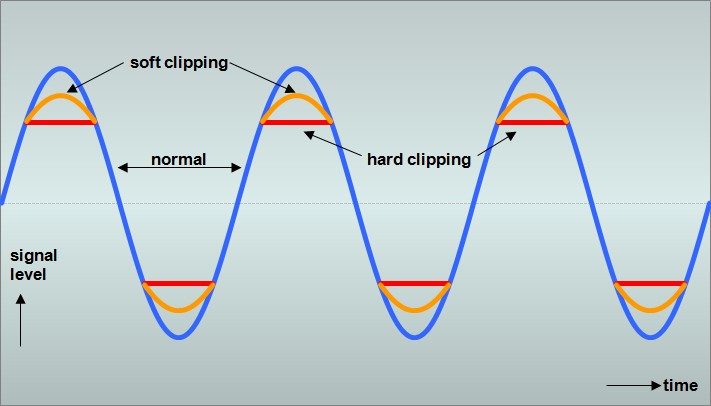
Imagine a guitar signal as waves drawn on paper.  Sharp mountain looking waves.  In Overdrive, these waves are rounded off.  They are squished, or compressed, and this creates fat, rounded hills rather than jagged waves.  They are fat sounding, and full of new harmonics and multiple frequencies in the same area.  You get your guitar's tone, but also just a bit of dirty signal.  You can either increase your guitar signal into the amp and overdrive the tubes in the pre-amp, or you can push the amp's volume to louder than it is meant to go and get a power amp overdrive tone.  This really decreased the lives of the early tubes(not to mention it made audiences deaf).  Later, players wanted to be able to do this all the time, so they created pedals that would boost the signal before it got into the amp.  This would guarantee overdrive, these were the first Overdrive/boost pedals.

After the pedals came to be used, players found that you could REALLY push that signal through and it would distort the sound into a crunchy, broken up sort of sound.  They created pedals or modded amps so they you could puts large amounts of gain through a tubed amplifier, and this created Distortion.  It is enough overdrive to lose some of the characteristics of the guitar your playing, but it created enough rich harmonic overtones that it still sounded musical.

One day someone went mad, and said "what if we just cascade the signal on top of itself in a pedal and caused it to get so broken that you can barely even hear the original guitar's sound" and low and behold, Fuzz was born.  Fuzz can get so strong that you practically can't hear the original guitar signal put into it, but it creates a nice, enveloping fuzzy pattern that still responded to the guitar player.

So as you can see, Overdrive, Distortion, and Fuzz are all related, and are almost steps in a sequence.  Its a bit of light, medium and heavy "dirt".  In a later post, I will explain why distortion is such a problem for bassists.  Hint: it has to do with that flat line in the picture at the start.  That flat line sucks.


Day 21

I went back into the lessons today and did the Double Stop lesson.  This is yet another guitar thing that I had heard of that I had never really learned what it was.  Turns out, I knew what it was, and I did a whole hell of a lot of it with playing bass lines.  Its just that I knew it as droning.  I am kind of let down by what it is, because it sounds more interesting than it is.  It is just two notes played at the same time and typically is not part of a chord.  Now, I'm not sure if doing a octave thing with it counts as being a double stop, but I do that a lot too, its one of the reasons I took to playing Everlong pretty easily.

Which is kind of funny.  I already knew how to do power chords because of the Green Day songs I had learned years ago.  I already knew how to do the octave parts because, well, I like to do octaves on bass, I've been doing that for years.  So the only real part that was holding me back on Everlong were the thought that it would be too difficult, and the Drop D tuning, which I never did before.

Today I also started playing with the Pentatonic major.  I have to say after playing tons of the minor scale lately, I really like the sound of the major.  For some reason it makes me want to make slower, soft rock music.  I had to record a little piece I came up with while just practicing it.  I've not memorized completely the pattern yet, but I'll be working on doing that for a while.  Repetition, it can get boring, but its the only way to learn.