Thursday, February 27, 2014

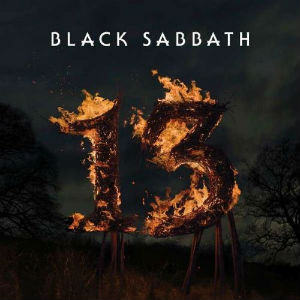
Album Thoughts: Black Sabbath 13


My first album thoughts post.  I suppose this is going to be a kind of "History of the band and I", then "track by track listening", and then "final summations".  Let's see how it goes.

First up, a little personal history with Sabbath, yea?  I mean, I'm not a magazine "journalist" or anything.  If you're reading this, I suppose you're a friend of mine.  So let's do this.  Sabbath is on my short list of all time favorite bands, and for sure the 70's era Sabbath is my favorite metal band of all time.  As of today, when you hear me play "metal" on my guitars, you probably hear more of Toni Iommi in my playing than anyone else.  Slow, pounding riffs interspersed with a tempo change, and maybe a solo.  I would have to say that in my own playing, "Into the Void" is tied with Hendrix's "Voodoo Child" for biggest inspiration.  My favor of the Gibson SG has just as much to do with my favor of Iommi as my favor of Angus.

I have to add a note here, and this will become important as you read my Album Thoughts, I listened to the Spotify version.  Come to find out, the Spotify version lists a selection of "bonus" tracks that aren't a part of the initial album release.  So my tracklist looks as follows:
1. "End of the Beginning"
2. "God Is Dead?"  
3. "Loner"  
4. "Zeitgeist"  
5. "Age of Reason"  
6. "Live Forever"  
7. "Damaged Soul"  
8. "Dear Father
9. "Methademic"  
10. "Peace of Mind"  
11. "Pariah"
*12.   "Dirty Women(live)"
*previous Black Sabbath song from older album

My first listen through, I could not help but hear earlier songs in the songs as I listened to them.  End of the Beginning has a strong semblance to the original song "Black Sabbath", Zeithgeist takes very clear inspiration from "Planet Caravan".  Is this bad?  Well the first parts of the album are not going to be any game changing songs for me, but you know what?  It sounds like Black Sabbath.  Probably my favorite part of the first 4 songs is "Give me the wine, you keep the bread".  At first it sounds like something a drunk would say, but remember that wine is also blood in the Christian communion.  That's classic Sabbath lyrical content right there.  End of the Beginning and God is Dead get a lot of promotion, which I think is sad because its the least interesting songs of the album. The next 4 tracks get away from this "We gotta sound like Black Sabbath" formula stuff.  Age of Reason is probably my favorite of these 4 tracks.  Its epic and varied.  Live Forever is musically sound, and well done, but I dislike the lyrics to the song and so its a killer for me.  Damage Soul reminds me of the earlier tracks of this album, but with the lyric style of the last few.  A pass for me.

So if you're connecting the dots here, this is not looking good for the album.  I was thinking the same thing, in fact that's where I stopped listening to it the first day.  I had other stuff to do.  The next day I was out smoking my pipe and decided to lug my tablet outside to listen to the rest while I smoked.  I re-listened to Damaged Soul just in case I had listening fatigue yesterday mess with my thoughts.  My thoughts pretty much staged the same.

Then.  It happened.

Dear Father started.  This... ok this sounds listenable... no wait, this is AWESOME.  FINALLY a song I think I will listen to more than once... probably alot.  If you look at the title and think we've gotten some Ozzy solo bleed over, some kind and sad song, you are mistaken.  This is a song about a priest living with the conscience of a sexual predator.  Probably 30 years too late to being "edgy", but the lyrics do hit home without beating around the bush.  No subtleness here, "you left my life in ruins", "you knew just what you were doing".  The riff is AWESOME.


And here is what I found out this morning as I sat down to write this.  This was the last track in the initial release.  WHAT?  You're telling me that if I bought the album as it was, I would get this great song and be left with no where to go? NOOOOOOOOOOOOOOOOOO

Luckily we have 3 more tracks.

Methedemic.  It starts out all acoustic, and I let doubt creep in my mind.  Then, we get this fast tempo Sabbath song.  Not the typical Sabbath that the public thinks it is... and... and holy crap, did Geezer Butler wake up?  I think this might be the first time in the album I've heard him stand apart from Iommi.  Well Butler getting into it must have woke Iommi up too.  Let's see if this ride continues

Peace of Mind.  The next song starts out like a Sabbath song, like maybe it's going to be more "we need to sound like us"... for about 2 seconds, then the riff kicks in.  YES!  THIS IS A NEW SABBATH SONG.  This is fresh like their stuff in Sabbath Bloody Sabbath, but without SOUNDING like Sabbath Bloody Sabbath, is that confusing?  It doesn't sound "derivative" of their old stuff like End of the Beginning, it sounds like "new" Sabbath during their best.  Geezer is playing all over the place in a good way, Iommi is keeping up while not stepping on his toes.

Pariah.  A song about cults with Geezer and Iommi sped up.  Another quick playing song like Methademic and its good.  Geezer is nuts on this song too.  Where the hell was he in the first half of the album.. Wait, did I say first half?


How about the whole "real" album.  How did these "bonus" songs not get put on the album?  They are easily the best.  Look, I have owned albums by these guys outside of Sabbath.  Iommi's self titled was amazing, he had so many fresh and new ideas in it.  The whole initial 8 song release(until #8) I wondered where that Toni was.  Hell, Geezer is one of the best bassists of all time, and I forgot he existed while listening to the first parts of the album.  I was really worried, and the reason I stopped listening on track 7 yesterday is because I thought to myself "are there any songs you'll be re-listening to?" and I had to answer "no"  Then Dear Father kicked in, and the band showed up.  I have to wonder if the first tracks were some of the earlier recordings, and the last bit of the album was when they got serious about releasing it?  I can only speculate.

I've listened to Peace of Mind 3x during writing this and reading news this morning.  That wins as my pick of the album.  If this is the last of the new stuff from Sabbath, I feel like they did great.  I complain a bit about the beginning of the album, but really, there is nothing grossly rejectable.  By the end, the band shows why they are the Godfathers of Metal.


Wednesday, February 26, 2014

The Flute; Expanded


I was watching Cave of Forgotten Dreams last night, when the talk changed from cave drawings to paleolithic tools.  This was when I first found out about paleolithic flutes, and particularly the oldest one ever found.  The flute was carved from vulture bone, and was also found in the workshop of some paleolithic Da Vinci.  Carbon dating all the tools and pieces of art in the are gives evidence that the flute is 40,000 years old.

Made by a Master

The flute itself is a 5 hole flute.  The cool thing about this flute is that it is not only the oldest undisputed flute as of the movie, it is not just a simple hollow tube with holes.  This flute was the making of an artisan.  There are notches all along the sides.  The reason for this is that the bone was cut in half, long ways, and hollowed out using stone tools.  This, using the notches as a guide, the two pieces were put back together and sealed with an air tight sealant, perhaps a primitive animal glue.

The Sound

The flute was created with only the thought to sound pleasing to the ear of the maker.  The 5 holes do have markings, but it is believed these markings are just guidelines from the artisan, rather than a "known" system of flute making.  The closest approximation to modern instruments is that it is a Pentatonic based note pattern, instead of a chromatic or diatonic flute.

Some Time

To put this in perspective for myself, I looked up a few known facts about something made so far back.  When this flute was made, there were lots of animals that no longer roam the Earth.  The big cats; Sabertooth tigers and Cave Lion, were still alive and well known to the maker.  Tribes related to the maker would soon make cave drawings of Woolly Mammoths and Cave Bears.  The world certainly did not look the same, as the English Channel was a barren, dry piece of land because there were glaciers over the alps that were many thousands of feet thick.  The flute is twice as old as potter, thirty thousand years older than the oldest known bow, and it goes without saying that it pre-dates written languages, walled cities, and when this flute was made wheat was nothing but a wild grass.

Audience

Another animal that was still around when this flute was made was the Neanderthal.  It is virtually impossible that Neanderthal man did not have contact with homo sapiens of this era.  We can only speculate if it was peaceful or horrendous.  There is possibility that Neanderthals have heard us make our music with our instruments.  It is impossible for us to know if Neanderthals had their own music, but evidence suggests that if they did, it was voice or percussion based.  One of the distinguishing features of Humans is that our paleolithic sites have tools and art created out of bone, while Neanderthals have no such trinkets at their sites.  Therefore, one of the distinguishing features of modern humans compared to the neanderthals that died out is that we have complex music, and they did not.

Using tools to make music is a heritage of all humanity.

Monday, February 24, 2014

Day 60

I'll start by saying this:

The 60 Day Challenge is to set up some Facebook-like Ubisoft thing and keep it updated.  It is also to play an hour inside the game.  My Ubisoft page did not like to update, so it says I have a grand total of... 9 hours played, which is horse-shit.  Next, I did not stick to playing the whole hour inside Rocksmith.  I am going to practice wherever it inspires me to practice, and some days it was figuring out how far I can push my amp's tone shaping abilities; some days it was practicing unplugged on my porch while I watched it snow.  Some days I spent 4 hours doing nothing but Session mode.  Some days I did 45 minutes of Guitarcade and then switched to my amp.  So technically I did not take the 60 day challenge "correctly" so take that how you will.

Day 60

Before...

It has been 60 days since I started using Rocksmith.  When I began, I had some theoretical knowledge of what I was supposed to do with a guitar.  I had some years of experience playing bass guitar.  I could fake my way around to sounding like I could play something resembling blues.  I have a sound file of me trying to make what I understood as "power chords" sound like a song.  It is pretty terrible now that I listen to it.  My fingers were awkward past the strings that my bass had.  My picking was super sloppy, and so "wrong" that my finger nails were scrapping against the strings and hurting for days.  Fretting on the thinnest strings hurt like hell, and felt like the strings were going to shred my finger tips.  If someone showed me where to play, I could do some stuff... mostly sounding like a bassist trying to play guitar, but I could not come up with stuff on my own in a "correct" way.

After...
(next paragraph omits things I already learned by playing bass, the lists include only things I learn and attribute to Rocksmith)

After 60 days I have knowledge of the Pentatonic scales and how to use them in a band setting.  This is directly attributed to Rocksmith because I practiced with the bands in the Session section of the game.  I can improv play lead in whatever key a song calls for.  My picking has come full circle, I now have a much better attack on the strings, especially strumming.  My fingernails never touch the strings.  My fret hand no longer hurts when I use them all around the neck.  My fingers were numb for weeks while they got used to playing, but now have full feeling back in them, and retain their toughness with dealing with strings.  I have a few pages of chords that I know from memory and can switch between many of them fast enough to play songs.  I can sight recognize chords being played by people I watch.  I can improv in blues, rock, heavy metal, and I can imitate 60's psychedelic rock, 70's hard rock, 90's indie alternative and punk, and several types of metal.  I can do a little funk.  I now can palm mute, use double stops effectively, play harmonics and somewhat tremolo pick.

What of Rocksmith?

I know I'm forgetting to list stuff.  I think that's pretty good progress for 60 days with a "video game".  I can fully recommend Rocksmith 2014.  I also encourage people to not get the original 2013 edition, because all the things I highly love and have highly helped me are not features in 2013.  Easily the most amazing thing about Rocksmith 2014 is the session mode, followed by Guitarcade and then the tone designer.  I think that as time goes by I will find the Riff Repeater to be invaluable as well.  Things in Rocksmith 2014 have pushed me further than I could have gone on my own by just practicing an hour a day by myself.  I am much further than I thought I would get in the 60 days, not only in music theory and knowledge, but application as well.

Do I consider myself a guitarist?

That's a hard question.  I do consider myself a bassist.  So do I know as much on Guitar as I do on Bass?  I think perhaps so.  But then why will I not call myself a guitarist... it has got to be my hangup on chords.  I just will not consider myself a guitarist till I can sit in with someone and have them say "its (insert chord progression) in the key of (insert key)" and be able to play that.  In reality... if I have the balls to call myself a bassist, then I should be able to call myself a guitarist too.  If I was asked, I would say "I could play a little guitar".  So yea... I guess I'm a guitarist of the beginner variety.  I do not know if I approached this as a beginner guitarist would though.  I came at the game wanting to learn to be good at jamming and session stuff.  I'm not here to learn some songs, I'm here to learn what to do during ALL songs.  I'm not here to learn what someone came up, I'm here to learn how to come up with my own stuff.  My musical goal is not to have a band, and play concerts.  I want to get together with some friends, have some beers, and do some jam room rock.  I'm well on my way to being able to do that.

Where do I go from here?

I hope you enjoyed reading my blog.  I had fun doing the 60 day challenge, and I really hope to keep this pace in learning guitar.  If this inspires you to get Rocksmith, let me know, it would make my day.  Posts here will slow in pace.  It will be added into rotation in my main blog that I link to my real life friends, and so perhaps one post a week.

What about your playing?

I am going to continue playing the Guitarcade, especially because it is fun.  I am going to continue through the lessons as I come to things I need to know or practice.  Songs I am going to do differently.   I am going to come at the songs in game with a hybrid Rocksmith/Youtube approach.  The session mode is still my #1 source of practice and would be worth buying the game for alone.  60 days are over, but I know I've only begun, as cheesey as that sounds today.  The challenge never said that after 60 days you'd be a guitarist and know how to play a million different chords with only your pinky.  It is a great start, however, and I certainly could recommend a beginner to do a 120 day challenge.  Then a 180 day challenge, whatever keeps them practicing and playing.

Any final words?

Rocksmith is not a effortless method to learning guitar.  Someone that is used to figuring out video games and working on accomplishing achievements and moving on is going to have problems.  You can not approach it like a video game.  You have to approach it like learning anything else.  You have to redo lessons, you have to redo practice tracks, you have to repeat things over and over until it becomes muscle memory, and then do it again.  Rocksmith is a lesson plan, it is a teaching tool, it is a learning device and a guitar technique encyclopedia.  It is not a "get rich quick" scheme.

Do not under estimate the value of Ducks Redux.

Make something new.

Be creative.

If you're not creating,

you're consuming.

Be a creator, bring something new to this world.


Sunday, February 23, 2014

Justin.


I had a friend once that owned an Epiphone Les Paul like the one pictured above.

His name was Justin.

Of all my friends I feel like Justin and I had the same love of 70's rock music, taste in beer and wine, video games, cooking and pipe tobacco. His blue Les Paul had this big square Led Zeppelin sticker on the top, behind the bridge.  He took it off later, and it left this big faded square there.  He ended up sanding the finish and kind of destroying the guitar lol.  We used to be out under the garage, him with his guitar and me with my bass, and we used to noodle around a bit.  He did teach me to play a version of Sunshine in Your Love once, probably the 2nd song I learned on any instrument.

Justin passed away a few years ago.  Every single time I feel like I'm getting better at guitar, my heart hurts, physically it has pain.  Every time I pick up my guitar, I feel one of the only regrets I have.  I want to play guitar with my buddy so badly, but I can't.  I have dreams where I meet him and show him that I'm learning.  In my dreams, with him watching, is the only time that I can play 100% perfect.  I know he would have bought Rocksmith as soon as it came out, I"m sure of it.  He would have had so much fun with it, and I know he would have came over and we would have played the multiplayer stuff in game together.

I used to give him so much shit about liking the band KISS.  I am not a huge fan of KISS, they're just not my thing.  A bit theatric, and they had a disco album.  We once watched a live concert of KISS while having a few beers, and Paul Stanley came up and said his famous line "You wanted the best, you got the best" and I mimicked that except I said "You wanted the best, but all we have is KISS!" and I used to say that all the time to Justin, just to give him shit, and laugh.

He got the last laugh though.  Because one day I'm going to have a Les Paul style guitar in blue.  And every time his birthday comes around, I'm going to play a new KISS song in his memory.

Day 59

Just a practice day.  Nothing new to report.  I"m playing around with staying in the same key, moving from minor to major Pentatonic.  I feel like I need to look up some suggestions and advice on doing so.  I feel like I'm on the edge of where i need to seek out advice in general too.  There are things I see players do, or things I hear them do, in their jam sessions that I really need to learn.  Its hard to learn such a thing unless you're there.  Its hard to articulate what you're asking unless you are there and they are playing and you say "that, that right there, show me how you did that".  Search engines are kind of too ambiguous to be able to do that.  The best you can do is look up "tricks" on youtube and hope the thing you want to know is one of them.

Saw something on Rob Chapman's channel today.  If you read this frequently, I talk about loving to play in the key of G, and how I really think the G chord sounds great to my ears.  Chapman put up videos about the new Gibson 2014 line of guitars, and in it he says to Cap-10 "I swear, maybe I'm crazy, but I swear that G sounds the best on a Gibson SG", which is the guitar I use.  So I wonder if I would have liked G so much if I had been playing another instrument instead?  I just think its weird that this comes up weeks after I first said I liked G.  Makes me think maybe I have a better ear than I thought?  Who knows.

Tomorrow's post will be my 60 day recap.  I don't really know what I'm going to write, but I'm assuming I'm going to outline where I'm going on my blog in the future, if I decide to continue it.  The blog has helped me keep at it as much as having Rocksmith itself.  Anyway, tomorrow, whole post dedicated to my 60 day challenge ending.

Saturday, February 22, 2014

My bass and Day 58

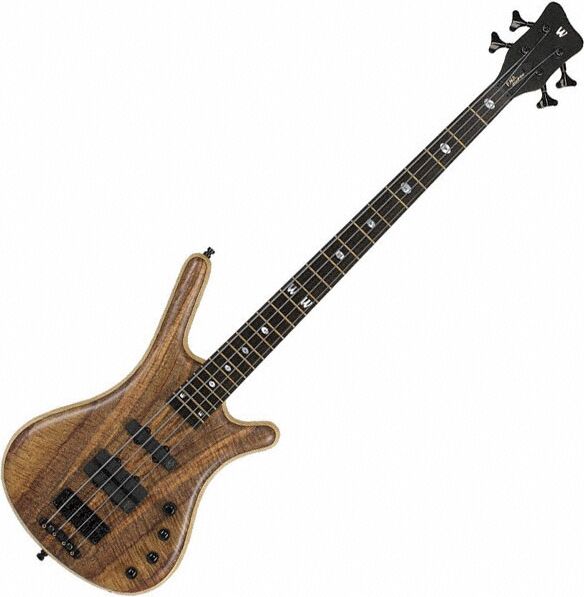
My bass.
Well, not my actual one, but the same model.

Where as my father was the one that helped me get my guitar equipment, it was my mother that helped me get my bass guitar.

How far do I go back?  Well.  I never liked the look of Fender instruments.  They looked too much like the era of cars I was never much into either.  One day, while waiting for a friend to show up at a gaming shop, I went into the music shop next door.  In there I saw, for the first time, a group of Warwick basses.  These were unlike the stereotypical bass.  They did not have an inch of thick paint and finish.  They did not have these gigantic guitar inspired bodies.  They looked like a piece of wood carved by hand into theses slick shapes that I had never seen before.

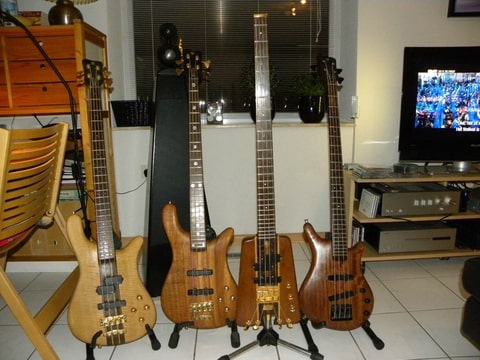
(pictured: someone luckier than I with a collection of Warwick basses)

It inspired me to pick up and play bass as my main instrument.  I only casually looked at them, far too scared to touch instruments of this quality and cost.  In fact, the cost of such instruments(a fraction of what they cost now actually) made my heart sink, but it was something to aspire for.  There was one in particular though.  This one was unlike the others as well.  It was this creamy white... like the whole thing was made out of the same wood.  When I moved around it, the woods shimmered as if it was a holograph... but it wasn't paint or holograph, it was a natural feature of the wood.

Years later I would be in a good job making enough money that I could possibly spend it on such a luxury.  I know good gear doesn't make you a good player, but I wanted not excuses.  If I sounded like shit with the best gear I could hope to have, then I had only myself to blame.  Its motivation for me.  I found out that, just my luck, this bass was a limited edition.  Only made in the year 2003.  The 2003 Bleach Blonde Thumb bass.  I spent time looking for it, this was before it was so easy to find good stuff on the internet.  I went to music shops all around for the next year and 1/2.  I found a 2004 special edition, which was nothing like my white whale, in North Carolina.  I was brave enough to play it, and it made me want my 2003 so much more.
(Pictured: 2004 ltd Corvette)


I wanted this Bleach Blonde Thumb bass so badly that when I petitioned a friend to paint a piece of art for me, and I told them "whatever you want to do", they found the silhouette of a thumb bass and did that.  By the time the painting was done though, it had happened.  I found the bass online for sale at a major retailer.  The problem was, my credit was not good enough to get an account to buy the bass.  I just did not have the credit history.  So my mother checked her rating and it was 1 dollar over what the bass cost.  She let me order it using her credit, and soon I had my dream bass.


I've learned a lot with this bass.  I've learned that I don't deserve it, and I'm not good enough to own it, but I work at getting that good.  I learned I shouldn't own a bass I'm too afraid to hurt, ha.  I've learned how to work on necks, adjust bridges, and fiddle with pre-amps.  She has the sweetest, smoothest high registers I've yet to hear in a bass, and sometimes I get a fleeting amount of inspiration and make her sing like she really wants to.  People warn about going out and getting an instrument that's too good for you, but sometimes it can teach you humility.  Sometimes it works out.

Day 58

Better late than never.  Still, I got the post in before the deadline ha.

I did play today, I just had things to do so I did not get the blog post done before I left the house.  Rocksmith was a little rushed.  I did 2 String Skip Saloons, 5 Scale Racers till I crashed, 2nd level of Castle Chordead till I died once, and a Gone Wailin' just because it had been a while.  Then I went to practicing over on the amp.

I'm doing this thing where I'm remembering older 70's rock songs and just trying to play stuff that sounds similar to the main riffs.  I'm moving around the neck and trying to pick out where it sounds most accurate.  Maybe its helping train my ear?  I have no idea, but I'll learn how close I was to a few of them later.  With this exercise I'm coming up with some good sounding stuff myself.  Stuff that sounds nothing like what I"m remembering in my head, but stuff that still sounds good.  One of my favorite riffs is from me wanting to play something that sounds like "Magic Carpet Ride" on guitar.  Its a song that I know the bass part of, one of the earliest I learned the bass part of, and so one day I'd like to be able to play it on guitar.

I need branch out a little bit.  I know I feel an affinity to 70's rock, and blues based blues, but there's this whole section of light 'airy" rock riffs that I'd like to learn.  I want to be able to copy John Fusciante's style in case I ever play with my one really good bass friend again.  Higher registers just don't sit well with my ears, and I'm not really good at using them to produce music, so its something I really need to work on.

Friday, February 21, 2014

Gaining volume and day 57

Gain and Master Volume


To a bassist using solid state, the relationship between these two are very confusing.  To a guitarist, it is a little more obvious.  If you ask both what gain is, they'll usually give you a blank stair, and the guitarist will talk about getting a dirty signal.

If you look at a guitar as a signal transmitter, you can perhaps understand gain a bit more.  The signal from your guitar is relatively low, that is why passive instruments with no batteries are still the most prevalent.  The current created by the magnets and the strings is enough of a signal.  When it gets to your amp, it will encounter 2 stages in most amp designs.  The first stage is the "pre-amp".  This is the stage where this tiny, small signal gets boosted.  This is where your tone is "shaped", if you are to make changes to a signal, its much easier to fine tune the signal if it is larger. That is what the Gain does, its a knob that increases how big you transform your signal.  If you make the signal very large, you get pre-amp distortion.

(Pictured: to the left are the small pre-amp tubes, to the right are the large power amp tubes)

After the first Gain stage, the pre-amp, the signal goes to the power amp stage.  Again, this stage takes whatever signal you give it and makes it much larger so that it can power the speakers enough to make a mechanical transition of the signal.  If you have boosted the signal to great levels in the pre-amp using gain, then it will distort this power section as well.  It also means you get a HUGE increase in volume.  Power amp distortion causes the tubes to get very hot, and will wear out your amplifier components.  Power amp tubes will glow with the fire of a thousand suns when overdriven hard.

(pictured: power tubes, some people aren't used to seeing things lit up like this in electronics unless its LED's)

That is why the Master Volume knob was invented.  It sits between the Pre-amp and power amp stages(technically it is pre-amp).  With it, you can bring down the signal strength before it gets to the power amp section, but it will let the pre-amp distortion through.  Pre-amp distortion is popular because it is much lower heat and voltage, and is also cheaper to do all around.  You can get that distorted sound while keeping the power tubes working at normal temperatures, and keep your ears from getting split from volume.

Solid state bassists, of which there are more than tube users these days, don't have this kind of distortion usually.  So how do they know how much gain to use?  Well... they get a helping hand.


Day 57

I have pretty much explored my guitar amp and can now manipulate it to do what I want fairly quickly.  Not too bad for having it for a decade right?  Yea lol.  I made it a point to know how amp EQ works with bass. A lot of people I've known that played kind of have these super complex and powerful EQ's and have no idea what they're for.  They max them or set it all at 12 o'clock and call it a day.  Then they talk about needing this or that pedal for this sound.  I wanted to get away from that.  It is a habit of mine to see that kind of stuff and want to not be that way.  When I got the Thunderfunk, I was like "I really REALLY need to educate myself if I'm going to have this kind of amp". I remember my bass bud coming over a good number of years back and him not being happy with not getting a Claypool sound.

"its gotta be his fingers or his carl thompson"

I informed him that Claypool likes to play full mids blasted.  A "frowny" if you look at it on a graphic EQ.  I EQ'd it in, and sure enough, there it was.  He then played Tommy the Cat and made me realize how much I suck at bass.  Anyway, recognizing EQ'ing and sounds has always been important to me.

So far I switch between as light a distortion as this amp can get(which is not very light lol) and a high gain metal sound, which it is surprisingly good at doing.  Sometimes it gets pretty fuzzy too.  I have some stuff to learn about the frequencies and how they interact with the band.  Like, I don't know the mid frequencies in Guitar, so I don't know if boosting them will interfere with the bass player's sounds.  The whole reason you do not want to scoop a bass live is that you kill "your" frequency.  You boost where you overlap with the drums, and you muddy up the guitarist by interfering with his highs, while your relatively instrument free play area of the "mids" is cut all to hell.  That's a "scoop", and its only great in your bedroom.  I need to research the guitarist's play area.  It sure seems a lot of people scoop a guitar and it seems more accepted.


Thursday, February 20, 2014

The Perfect Circle and Day 56

Getting a little nerdy here, but maybe you'll find it interesting.  The first part might look like a text book, but keep going.

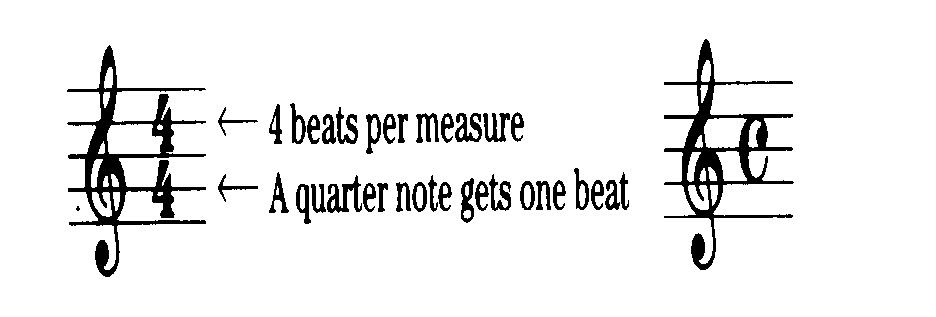
Most western music is separated into a measure.  This is a musical unit that transcends all instruments.  When written down, you see a fraction used to help tell you how to play the piece of music.  The most common notation is 4/4, and it is called "common time signature".  It is literally the most common found.  From blues rock, to pop music, 4/4 is found all over the place.  On paper it looks like this:


What the numbers mean is pretty easy, and this isn't really an educational post.  The first or "top" number is the number of beats in the measure, and the bottom number is the length of the notes.  This means 4/4 means 4 quarter notes used in each bar.  Don't dwell on that too much.  What we're looking at today is the C that is written there.

Well, 4/4 time is known as several things.  The term "Common Time" is a more recent one that has come over time.  Many people think that the "C" there is for common time, but the notation is older than this name.  The "C" came many many years before the fact that 4/4 emerged as the most common.  We need clues.  Well 4/4 is also known as "Quadruple Meter".  That one is simple... maybe not any help to us.  It is also called "Imperfect Time".  Oh, hey, there we go.  Imperfect time.  If 4/4 is imperfect, what is "Perfect".  The time signature of 3/4 is "Perfect Time".  But why?  Well what changed.  There's a 3 in there.


When all this notation was being created, much of it was for religious usage.  The bulk of higher educational music was being done by the Church for their choirs.  Is there any Christian religious significance to the number 3?  The Holy Trinity.  This is why it is considered perfect, it is a holy number.  To Christians perhaps the holiest number.  The problem is that there are so many numbers used in notation, it could be confusing, so they needed another symbol for "perfect".

That's where the "Perfect" circle comes from.  A circle is a continuous line going on forever, unchanging, and perfect.  So 4/4 timing is not so perfect, its "Imperfect", but its close.  How do we show that something is "Imperfect".  How about a broken circle?  That's right!  The C used to represent 4/4 timing is not a "C" at all, so it can not stand for Common Timing.  It was originally a broken circle to stand for Imperfect Timing.

Day 56

Yesterday I had the epiphany that the Minor and Major Pentatonic overlapped in a way that certain shapes were the same on either side, and opened a huge amount of alternate ways I could play along in certain keys.  Today I learned that you can take the shapes you like, and find them in the same key in both minor and major pentatonic.  Because I am new, it is the first minor pentatonic shape(E at the 12th fret) that I know well and can call upon the easiest when I'm doing improv phrasing.  Now I know that if I just shift my hand and keep the same shape, I hit the MAJOR E pentatonic at fret 9.  That is super close and makes it very easy to have a kind of duality to my improv in a very simple way.

I really should just focus on learning the other shapes as well, and combining them.

I still have my same flaw, through all of this new playing and learning.  I learn, and I can talk theory, but I'm not as good with the application.  This is my same flaw in many hobbies and non-hobbies.  I'm strong on the "book learnin'" and not so much on the application.  I call it the "lazy supervisor gene" or some such.  It seems to do nothing but piss people off haha, including myself.

Along with Knockin' on Heaven's Door, which I need to play more but the Pentatonic realization has had me practicing other things lately, I have been playing some other songs just to... I don't know, test the waters? or some other appropriate phrase.  It feels really good to be watching and realizing what the favored scale of a song is.  I'm not "there' yet, but I'm getting able to see what's underneath a song.  That these songs aren't just magic that take place, but are methodical in approach.  Actually, I am quite looking forward to finding a good song that defies my ability to classify and "see" the method.